
How to Buy a Business With Little Money Down: Realistic Options
The idea of buying a business with little or no money down is appealing, and you will find plenty of content online promising it is easy. The reality is more nuanced. It is genuinely possible to acquire a business while contributing far less upfront cash than the full purchase price, using legitimate financing structures. But doing so sensibly requires the right business, the right structure, and a clear understanding of the risks. This guide sets out the realistic options, without the hype.
Here we explain how to buy a business with little money down in Australia: the legitimate structures that reduce the cash you need upfront, what makes a business suitable, what you still need to bring to the table, and the risks worth weighing before you commit.

Can You Really Buy a Business With No Money Down?
You can often buy a business with far less upfront cash than the full price by using structures such as vendor finance, earnouts, leveraged acquisition funded by the business's own cash flow, and outside investors. Buying with literally zero of your own money or input is rare and usually unwise, but reducing the cash you contribute upfront is realistic for the right business with a sensible structure.
The structures below explain how. For the broader funding picture, see our guides on how to finance a business acquisition and the full costs of buying a business in Australia.
The Honest Truth About "No Money Down"
Before the structures, a dose of realism. Genuinely buying a quality business with none of your own money, skill, or risk is rare, and deals that look too good usually carry a hidden problem. What is realistic is reducing the upfront cash you contribute by using finance, seller terms, and the business's own cash flow. Even then, lenders, sellers, and investors will want to see something from you: capital, relevant experience, creditworthiness, or a credible plan to run the business. Approaching this honestly, as a way to structure a sound acquisition efficiently rather than a way to get something for nothing, is what separates a smart deal from a risky one.
Realistic Low Money Down Structures
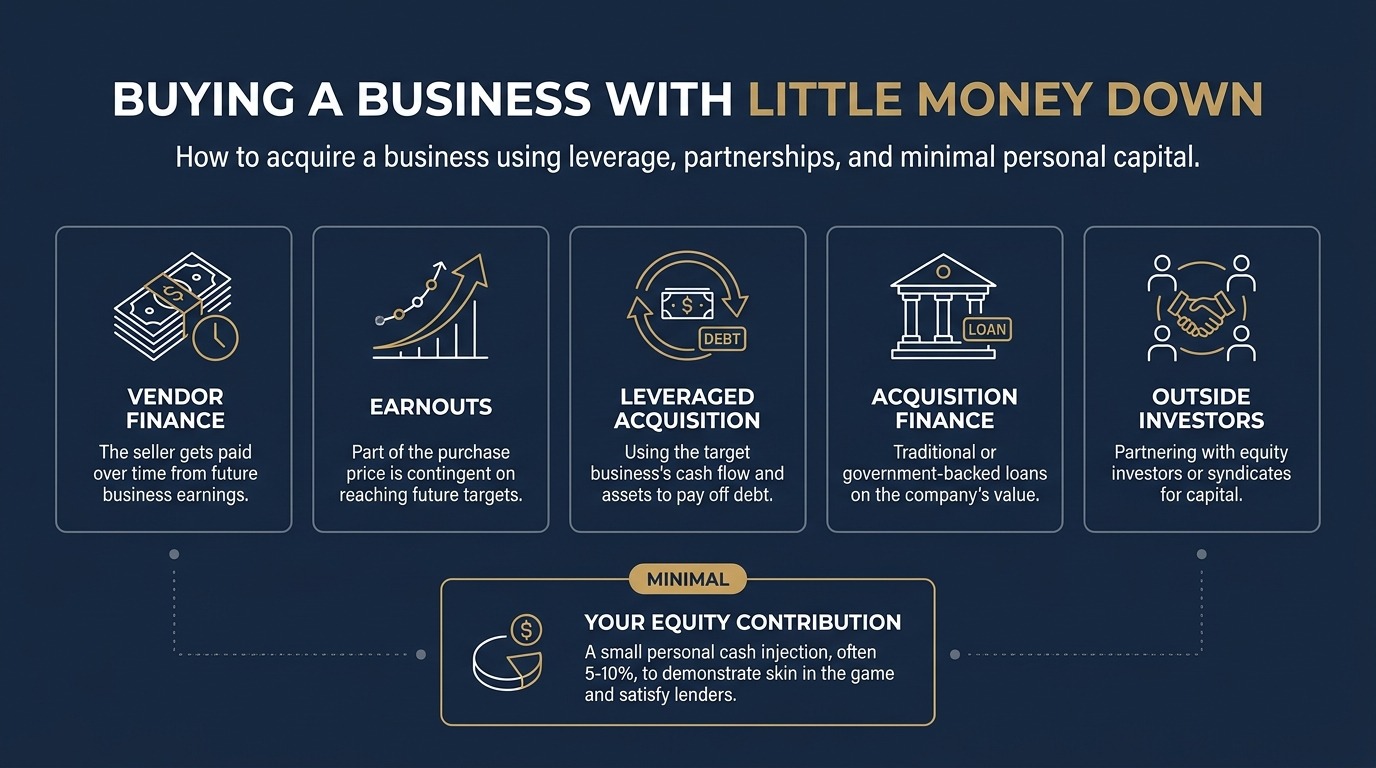
1. Vendor finance
Vendor finance, where the seller allows part of the price to be paid over an agreed period after completion, is one of the most common ways to reduce the cash required upfront. The seller effectively finances part of the sale, and the deferred amount is paid from the business's future cash flow. It can also signal the seller's confidence in the business. Our guide on earnouts, vendor finance and deal structures explains how this works in practice.
2. Earnouts
An earnout ties part of the purchase price to the business achieving agreed performance after completion. This reduces your upfront outlay and aligns risk between you and the seller, because a portion of the price is only paid if the business performs. It works best where both parties are confident in the outlook and the targets are carefully defined.
3. Leveraged acquisition (using the business's cash flow)
A core principle of many acquisitions is that a business with strong, stable cash flow can help fund its own purchase. Debt used to buy the business is serviced from the cash flow the business generates. The stronger and more predictable that cash flow, the more of the purchase it can support, reducing the equity you need to contribute. This is the same principle private equity firms use, on a larger scale.
4. Bank or acquisition finance
Banks and lenders may fund part of a purchase where the business has demonstrable cash flow to service the debt and adequate security is available. The amount depends on the business, the security, and the lender's assessment. Combined with vendor terms, this can significantly reduce the cash you contribute directly.
5. Outside investors or partners
Bringing in co-investors or partners who contribute capital in exchange for equity lets you acquire a business you could not fund alone. The trade-off is sharing ownership, control, and future profits, so the terms need to be clear and the partnership well chosen.
6. Combining structures
In practice, most low money down acquisitions blend these approaches, for example, vendor finance plus acquisition finance plus a modest equity contribution. The right combination depends on the business, your position, and what the seller and lenders will accept.
What Makes a Business Suitable for Low Money Down
Not every business can be bought this way. The structures above depend heavily on the business having strong, stable, and predictable cash flow, because that cash flow is what services the debt and funds the deferred payments. A business with reliable recurring revenue, healthy margins, and low owner dependency is far more suitable than one with volatile earnings or heavy reliance on the current owner. Assessing this properly is where due diligence matters most.
What You Still Need to Bring
Even a well-structured low money down deal usually requires something from you beyond cash. Lenders and sellers want to see creditworthiness, relevant experience or capability to run the business, and a credible plan. The less cash you contribute, the more these other factors matter, because the people financing the deal are taking on more of the risk and need confidence in you. Treat "little money down" as a reason to be more prepared, not less.
The Risks of Buying With Little Money Down
Lower upfront cash often means higher leverage, and higher leverage means higher risk. A business carrying significant debt or deferred payment obligations has less margin for error. If trading dips, servicing that debt becomes harder, and the pressure falls on you. Over-leveraging is a genuine risk, and it is one reason to be realistic about how much the business can comfortably support. A deal that only works if everything goes perfectly is a fragile deal. Our guide on common first-time buyer mistakes covers this and related traps.
How to Structure the Right Deal
The key to buying with little money down successfully is matching the right business to the right structure, and not over-reaching. That means finding a business with genuinely strong cash flow, verifying it through proper due diligence, and structuring the funding so the business can comfortably service its obligations with room to spare. Our guides on how to find a business to buy and the step-by-step acquisition process walk through this.
Getting Help to Structure Your Acquisition
Structuring an acquisition with limited upfront capital is where experienced guidance is most valuable, because the structure has to genuinely work. A specialist buy-side advisor helps you find suitable businesses, verify the cash flow, and structure funding that is sustainable rather than fragile.
Blackmont Advisory acts as an exclusive buyer advocate for acquirers across Australia, including those structuring acquisitions efficiently. As a boutique, senior led M&A firm based in Melbourne with a global network, we work exclusively for you, helping you find the right business and structure a purchase you can realistically fund and sustain. See our complete guide to buying a business for more.
Buying a business with little money down is genuinely possible for the right business and the right buyer, provided you approach it realistically, structure it soundly, and respect the risks that come with higher leverage.
Looking to acquire a business? Register your acquisition brief.
This article provides general information about financing structures for buying a business and is not personal financial, tax, or legal advice. Buying with high leverage carries real risk. Speak with a qualified adviser about your specific circumstances.
Frequently Asked Questions
Can you buy a business with no money down? Buying a quality business with literally none of your own money, input, or risk is rare and usually unwise. What is realistic is reducing the cash you contribute upfront using structures such as vendor finance, earnouts, leveraged acquisition funded by the business's own cash flow, and outside investors. Even then, lenders and sellers will want to see capital, experience, or a credible plan from you.
What is the best way to buy a business with little money down? Most low money down acquisitions combine structures, such as vendor finance, acquisition finance, and a modest equity contribution. The best approach depends on the business and your position. The essential ingredient is a business with strong, stable cash flow that can comfortably service the debt and deferred payments.
What is vendor finance when buying a business? Vendor finance is where the seller allows part of the purchase price to be paid over an agreed period after completion, effectively financing part of the sale. It reduces the cash you need upfront, is paid from the business's future cash flow, and can signal the seller's confidence in the business.
Is it risky to buy a business with little money down? It can be. Lower upfront cash usually means higher leverage, and higher leverage means less margin for error. If trading dips, servicing the debt and deferred payments becomes harder. A sound deal is one the business can comfortably support with room to spare, not one that only works if everything goes perfectly.
What kind of business can you buy with little money down? Businesses with strong, stable, and predictable cash flow, healthy margins, and low owner dependency are the most suitable, because that cash flow is what services the debt and funds deferred payments. Businesses with volatile earnings or heavy reliance on the current owner are far less suitable.