

When a business is sold, the headline price is only half the story. How that price is actually paid - all cash at completion, part deferred, part tied to future performance, or part rolled into a retained stake - often matters just as much as the number itself. Understanding business sale deal structures, and terms like earnout, vendor finance and retained equity, is essential for any owner or acquirer who wants to compare offers on their real merits rather than the headline figure alone.
This guide explains the main M&A deal structures, how each one works, who it favours, and how to evaluate an offer on a genuine like-for-like basis.

What Are the Main Business Sale Deal Structures?
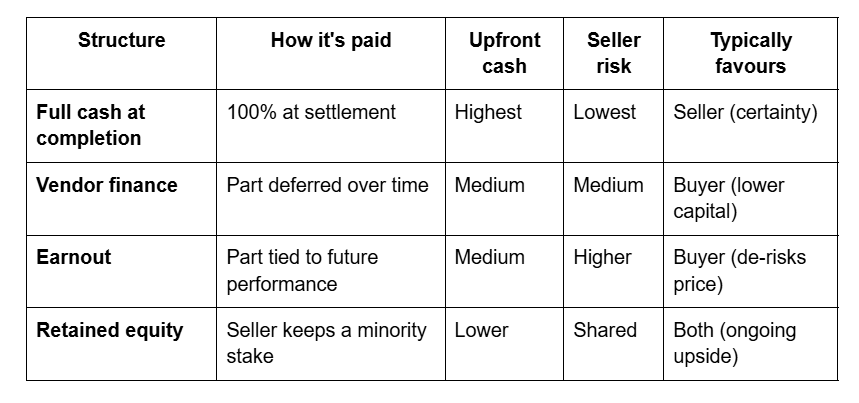
The four main deal structures are full cash at completion, vendor finance (deferred consideration), an earnout (payment tied to future performance), and retained equity (the seller keeps a minority stake). Most real transactions blend two or more of these to balance the buyer's risk and capital against the seller's objectives.
Understanding each is a core part of the fundamentals covered in our merger and acquisition basics guide and business acquisition explained.
Why Deal Structure Matters as Much as Price
The structure attached to a price determines how much you actually receive, when you receive it, and how much risk you carry. A higher headline price paid largely through an earnout may be worth less, in real terms, than a lower price paid mostly in cash at completion. This is why the highest offer is not automatically the best offer.
For sellers, understanding structure means you can weigh certainty against upside. For buyers, it is a tool to manage risk and preserve capital. Either way, the structure is where a significant part of the value - and the risk - actually sits.
The Four Core Deal Structures at a Glance
Full Cash Acquisition
A full cash acquisition is where the buyer pays the entire purchase price at completion. It offers the seller a clean, immediate, certain exit - but because it requires the buyer to be fully capitalised upfront, it sometimes comes at a modest discount to the headline value achievable through a deferred structure.
Full cash suits sellers who prioritise certainty and a clean break over squeezing the last dollar of headline value.
What Is Vendor Finance?
Vendor finance (also called vendor or seller finance, or deferred consideration) is where the seller allows part of the purchase price to be paid over an agreed period after completion - effectively financing part of the sale themselves, often over around two years.
Vendor finance can achieve a higher headline price for the seller while reducing the buyer's upfront capital requirement, which can widen the pool of capable buyers. The trade-off for the seller is risk: the deferred amount depends on the buyer's ability to pay it. That risk should be managed through security, interest, and clear terms - and understood before agreeing. How buyers use these structures to fund deals is covered in our guide on financing a business acquisition.
What Is an Earnout?
An earnout is where part of the purchase price is contingent on the business achieving agreed performance targets - such as revenue or EBITDA - over a defined period after completion. If the targets are met, the seller receives the additional payment; if they are not, that portion is reduced or lost.
Earnouts align risk between buyer and seller: the buyer avoids overpaying for performance that doesn't materialise, and the seller can share in upside they believe is achievable. But earnouts are also the most disputed structure in M&A, because the outcome depends on how the business is run after the seller has sold it. The mechanics matter enormously - how targets are defined and measured, who controls the business during the earnout period, and how disagreements are resolved. A poorly drafted earnout is a common source of post-completion disputes.
Sellers considering an earnout should negotiate the targets and mechanics carefully, ideally with an experienced advisor, and understand what portion of their total price is genuinely at risk.
What Is Retained Equity?
Retained equity (sometimes called rollover equity, or "a second bite of the cherry") is where the seller keeps a minority stake in the business after the sale, rather than exiting entirely. The seller receives cash for the majority of the business now, while retaining exposure to its future growth under the new owner.
This structure is common in private equity transactions, where the buyer wants the founder to stay invested through the next growth phase, and appealing to sellers who believe in the business's future and want to benefit from a second exit later. Our guides on private equity and family offices in Australia explain how different buyers use retained equity.
Blended Structures
In practice, most mid-market transactions blend these structures - for example, cash at completion plus a vendor-finance component plus a modest earnout, or cash plus retained equity. Blending allows the buyer to preserve capital and manage risk while giving the seller a combination of certainty and upside. The right blend depends on both parties' risk appetite, the buyer's available capital, and the seller's objectives for the proceeds.
How to Compare Offers on a Like-for-Like Basis
Because structure changes the real value of an offer, you cannot compare deals on headline price alone. To evaluate offers properly, look at how much is paid in cash at completion versus deferred, how much is genuinely at risk (earnout), the terms and security on any deferred amount, and the tax treatment of each component.
An offer with a lower headline price but more cash upfront and less risk may be worth more than a higher, heavily contingent one. This is one of the clearest areas where experienced representation adds value, as covered in why using a specialist advisor maximises your outcome. Getting to a defensible view of value first - through an honest valuation and understanding how businesses are priced to sell - is what lets you assess structure sensibly.
Tax and Timing: Plan Structure Early
Different deal structures carry different tax and cash-flow implications, and these are decided during negotiation - so planning for them before terms are agreed can materially affect what you keep after tax. This is why engaging a financial and tax advisor early, alongside your M&A advisor, matters. Our article on what a high net worth financial advisor does when you sell and our exit planning approach explain how to build this in from the start.
Getting the Structure Right
Blackmont Advisory structures transactions to align both parties' interests and protect our clients' outcomes - negotiating not just the headline price, but the cash, deferred, earnout, and equity components that determine what a seller actually receives. As a boutique, senior-led M&A firm based in Melbourne with a global network of buyers, we manage every mandate from first meeting through to settlement. For the full picture, see our complete guide to selling a business or guide to buying a business.
The right deal structure is rarely the one with the biggest headline number. It is the one that best balances value, certainty, and risk for your specific circumstances.
Weighing up an offer or planning a sale? Start with a confidential valuation.
This article provides general information about business sale deal structures and is not personal financial, tax, or legal advice. Speak with a qualified advisor about your specific circumstances.
Frequently Asked Questions
What is an earnout in a business sale? An earnout is a portion of the purchase price that is contingent on the business achieving agreed performance targets (such as revenue or EBITDA) after completion. If the targets are met, the seller receives the payment; if not, it is reduced or lost. Earnouts align risk but are the most disputed structure, so the targets and mechanics must be carefully negotiated.
What is vendor finance when selling a business? Vendor finance (or seller finance / deferred consideration) is where the seller allows part of the purchase price to be paid over an agreed period after completion, effectively financing part of the sale. It can achieve a higher headline price and widen the buyer pool, but the seller carries the risk of the deferred amount, which should be secured and clearly documented.
What is retained equity in a business sale? Retained equity, or rollover equity, is where the seller keeps a minority stake after the sale rather than exiting fully. They receive cash for the majority now and retain exposure to future growth - a "second bite of the cherry." It's common in private equity deals where the buyer wants the founder invested through the next growth phase.
Is the highest offer always the best offer? No. The structure attached to a price - how much is cash at completion versus deferred or at risk in an earnout - often matters as much as the headline number. A lower offer with more cash upfront and less risk can be worth more in real terms than a higher, heavily contingent one.
How do I compare business sale offers with different structures? Look beyond the headline price at how much is paid in cash at completion, how much is deferred or contingent, the security and terms on deferred amounts, and the tax treatment of each component. Comparing the real, risk-adjusted, after-tax value - not just the number - is the only sound basis for choosing between offers.