

If you are preparing to sell a mid sized business, one document will do more to shape how buyers perceive your business than any conversation, meeting, or pitch you deliver in person. That document is the Information Memorandum, often referred to as an investment memorandum or simply an IM. Understanding what it is, what belongs in it, and why quality matters so much is essential preparation for any owner considering an exit.

What Is an Investment Memorandum?
An investment memorandum is a comprehensive, professionally prepared document that presents a business to prospective buyers, covering its financial performance, operations, market position, growth opportunities, and proposed deal structure options.
It gives buyers the structured information they need to assess whether the opportunity fits their acquisition brief. Think of it as the primary tool through which a buyer forms their first serious impression of your business, well before any face to face negotiation begins. A weak or poorly prepared IM can cause a genuinely strong business to be overlooked, while a well prepared one can generate serious interest even from buyers who were not initially searching for a business exactly like yours.
Why Do Investment Memorandums Matter When Selling a Business?
The IM determines whether your business survives a buyer's initial screening. Serious buyers review a large number of opportunities, and the memorandum is what decides whether yours makes it past that first cut and protects your price later.
Serious buyers, whether private equity firms, family offices, or experienced individual acquirers, review a significant number of opportunities before pursuing any single one seriously. Beyond the first impression, a properly prepared investment memorandum also protects the seller. By presenting verified, accurate information upfront, it reduces the risk of price renegotiation later in the process, when buyers might otherwise discover unexpected details during due diligence. Investment memorandums also allow a controlled, staged release of sensitive information, giving enough detail to generate genuine interest without disclosing your most commercially sensitive details before confidentiality is agreed and a buyer's seriousness is established.
What Should an Investment Memorandum Include?
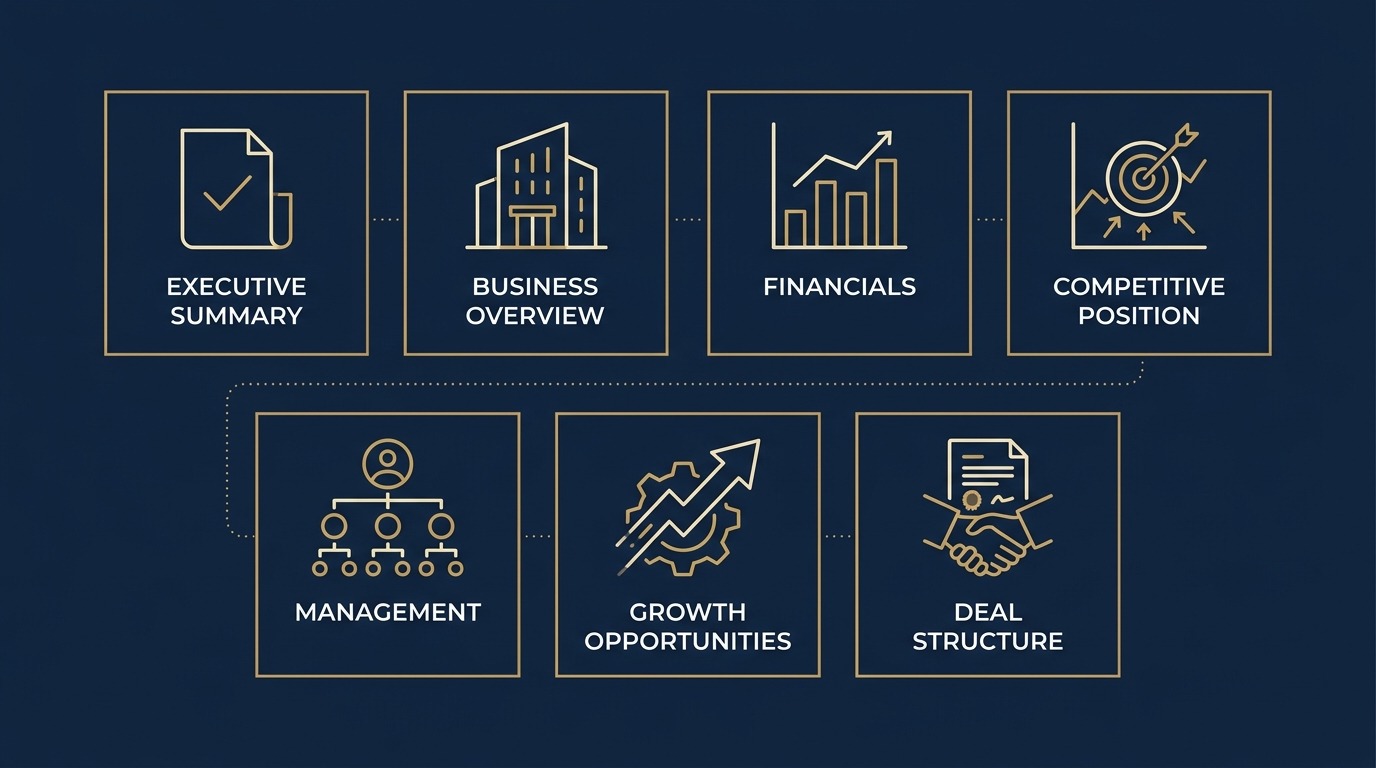
A credible IM for a mid market business typically includes seven core sections: an executive summary, business overview, financial performance, market and competitive position, management structure, growth opportunities, and deal structure considerations.
Executive summary. A concise overview of the business, its market position, and the investment opportunity, designed to capture attention and encourage the buyer to continue reading.
Business overview. A detailed description of what the business does, its history, its products or services, and its operational structure.
Financial performance. Historical financial statements, normalised earnings, key metrics, and, where appropriate, forecasts supported by credible assumptions. Getting to a credible, defensible number is exactly what our confidential valuation helps establish.
Market and competitive position. An honest assessment of the industry, the competitive landscape, and the business's specific position and advantages within it.
Management and organisational structure. Information about the leadership team, staffing structure, and the extent to which the business depends on specific individuals.
Growth opportunities. A credible outline of the potential upside available to a new owner, whether through expansion, operational improvement, or strategic initiatives not yet pursued.
Deal structure considerations. An indication of the seller's preferred structure and flexibility, whether that is a clean cash exit, openness to vendor finance, or interest in retaining a minority stake.
The Difference Between an Investment Grade IM and a Basic Sales Document
An investment grade IM is prepared to institutional standards, with financial claims verified rather than simply accepted from the owner. A basic sales document is produced quickly, without that scrutiny - and sophisticated buyers can tell the difference.
This is one area where the quality of your advisor makes a genuinely material difference. A weaker document tends to generate less serious interest, and can actually damage buyer confidence if inconsistencies are discovered later. Given that this single document is often what determines whether your business receives a second look from the buyer most likely to pay a strong price, the investment in preparing it properly is rarely money poorly spent. This is a clear example of how the right advisor maximises your sale outcome.
How Does an Investment Memorandum Protect Confidentiality?
An IM protects confidentiality by enabling a staged release of information: an anonymous teaser gauges interest first, the full memorandum follows only after a confidentiality agreement, and the most sensitive details are withheld until later due diligence.
A well structured IM plays an important role in protecting confidentiality throughout a sale process. An initial teaser, without identifying the business by name, is used to gauge preliminary interest. Only once a prospective buyer has agreed to confidentiality do they receive the full investment memorandum, and even more sensitive information, such as detailed customer contracts, may be withheld until later stages of due diligence.
This staged approach allows sellers to generate broad market interest without unnecessarily exposing commercially sensitive information to parties who are not genuinely serious about transacting. It is a core part of the confidential sale process a specialist advisor runs.
Common Mistakes to Avoid
Even well intentioned sellers make avoidable mistakes when preparing an investment memorandum. Overstating growth prospects without credible supporting evidence is one of the most damaging, since sophisticated buyers will test every assumption during due diligence, and inflated claims that do not hold up undermine trust in the entire document. Omitting known weaknesses, such as a customer concentration issue or a recent decline in a particular product line, is another common error. Buyers will find these issues eventually, and it is far better for them to be addressed proactively within the IM than discovered later and treated as a red flag the seller tried to hide. Finally, presenting financial information inconsistently, with numbers in the IM that do not reconcile cleanly to the underlying accounting records, is one of the fastest ways to erode buyer confidence before negotiations have even begun.
How Long Does It Take to Prepare an Investment Memorandum?
Preparing an investment memorandum properly typically takes several weeks and requires close collaboration between the business owner and the advisor preparing it.
Financial information needs to be gathered and normalised, the business narrative needs to be developed and fact checked, and the document needs to be structured in a way that anticipates the questions serious buyers will ask. This preparation work, done properly before a business goes to market, is one of the most valuable investments a seller can make in the overall outcome of their transaction. Our guides on getting sale-ready and building a bulletproof exit strategy cover how to prepare well ahead of time.
Getting Your Investment Memorandum Right
Blackmont Advisory prepares investment grade Information Memorandums for every seller mandate we take on, covering financials, operations, and deal structure options to institutional standard. This is the document that positions your business compellingly to the private equity firms, family offices, and high net worth buyers within our network, and it forms the foundation of a confidential, well managed sale process from first outreach through to settlement. For the wider picture, see our complete guide to selling a business.
If you are considering a sale, understanding the role your investment memorandum will play, and ensuring it is prepared properly, is one of the most important decisions you will make before your business ever reaches a buyer's desk.
Preparing to go to market? Start with an exit readiness assessment.
Frequently Asked Questions
What is an investment memorandum? An investment memorandum (IM) is a comprehensive, professionally prepared document that presents a business to prospective buyers. It covers financial performance, operations, market position, growth opportunities, and deal structure options, giving buyers the information they need to assess the opportunity.
Is an investment memorandum the same as an information memorandum? Yes. The terms investment memorandum, information memorandum, and IM are used interchangeably to describe the same document - the primary information pack presented to prospective buyers in a sale process.
What should an investment memorandum include? A strong IM typically includes seven sections: an executive summary, business overview, financial performance (with normalised earnings), market and competitive position, management and organisational structure, growth opportunities, and deal structure considerations.
How long does it take to prepare an investment memorandum? Preparing an IM properly usually takes several weeks. Financial information must be gathered and normalised, the business narrative developed and fact-checked, and the document structured to anticipate the questions serious buyers will ask.
What is the difference between an investment grade IM and a basic sales document? An investment grade IM is prepared to institutional standards with verified financial claims, signalling a credible, well-managed process. A basic document produced without proper scrutiny generates less serious interest and can damage buyer confidence if inconsistencies emerge later.