

If you are preparing to sell a mid-market business, private equity firms are among the most active and well-capitalised buyers you are likely to encounter. But private equity firms are selective - they review a large number of opportunities and pursue only those that fit a defined investment thesis. Understanding what private equity firms look for in a business lets you see your own business through a buyer's eyes, and position it to attract strong interest and a strong price.
This seller's guide sets out exactly what private equity firms look for, what they avoid, and how to position your business before you go to market.

What Do Private Equity Firms Look For in a Business?
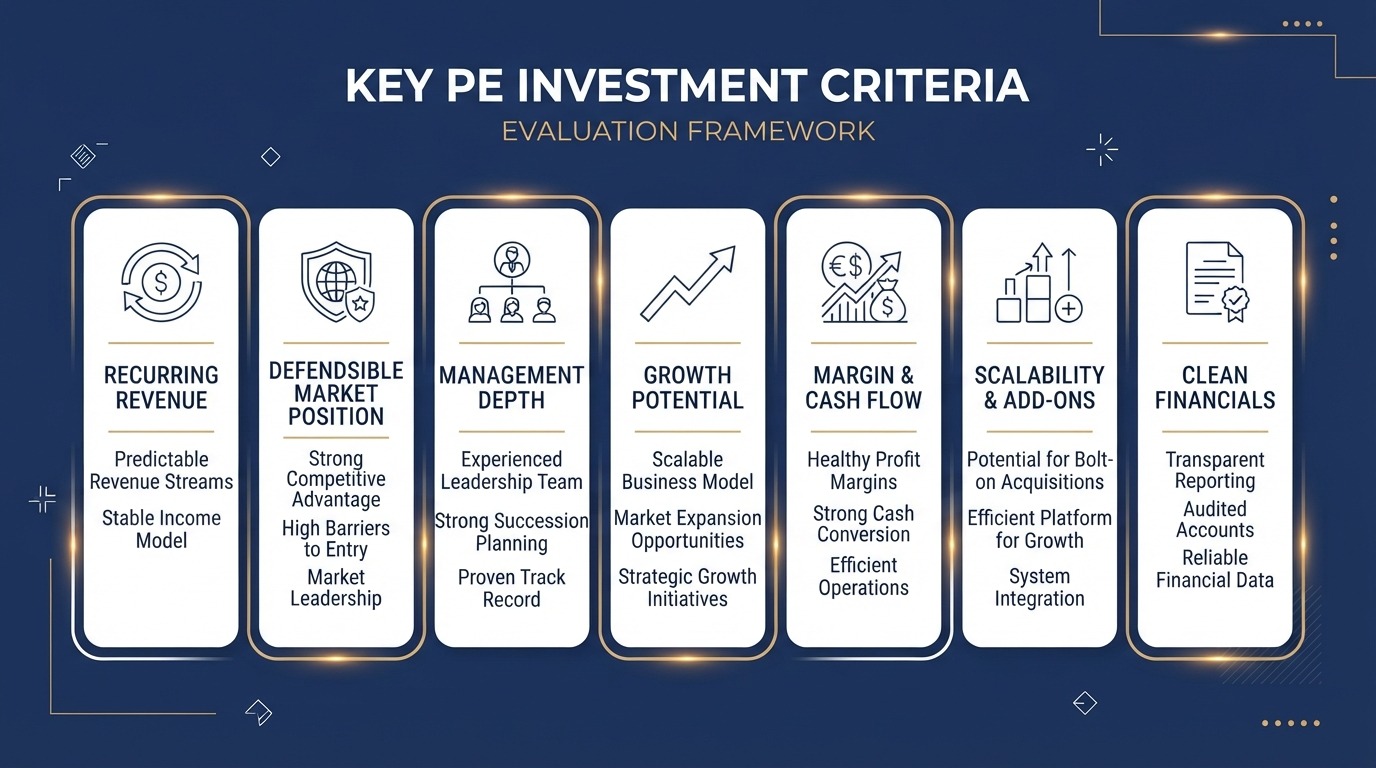
Private equity firms look for established businesses with recurring or predictable revenue, a defensible market position, management depth beyond the founder, consistent growth, healthy margins and cash flow, and a credible path to create further value. Because they acquire using pooled capital and work toward an exit, they favour businesses they can grow and sell on profitably.
Each of these criteria is explained below. If you want the fundamentals of how these buyers operate first, see our plain-English guide to private equity.
Why Understanding Private Equity Criteria Matters for Sellers
Knowing what private equity firms value puts you in a far stronger position. It lets you identify and strengthen the characteristics that attract PE buyers before you go to market, present your business in the terms a private equity firm actually assesses, and recognise whether a private equity firm is genuinely the right buyer for your business at all. For some owners, a family office may be a better fit - our guide on private equity vs family office compares the two buyer types.
The Criteria Private Equity Firms Assess
Recurring, predictable revenue
Private equity firms place a premium on revenue they can rely on. Contracted, subscription, or repeat revenue is valued far more highly than one-off or project-based income, because predictability reduces risk and supports the growth-and-exit model PE is built around.
A defensible market position
PE firms favour businesses with a genuine competitive advantage - strong brand, intellectual property, long-term contracts, scale, or a specialised niche. A defensible position protects future earnings and makes the business easier to grow and eventually sell on.
Management depth beyond the founder
This is one of the most important criteria. A business that depends entirely on its owner carries significant key-person risk. Private equity firms strongly prefer businesses with a capable management team that can run the business without the founder in the room, because PE typically wants to back and grow the existing team rather than replace the owner's daily involvement overnight.
Consistent growth and clear growth potential
PE firms are buying future value, so they look for a track record of consistent growth and, crucially, a credible path to grow further - whether through expansion, operational improvement, or add-on acquisitions. A clear, evidence-backed growth story is one of the most powerful things a seller can present.
Healthy margins and strong cash flow
Sustainable margins and reliable cash generation signal a well-run business and support the funding structures private equity uses. Businesses with thin or volatile margins are harder for PE to finance and grow.
Scalability and platform or add-on potential
Many private equity firms pursue a platform-and-add-on strategy: acquiring an initial platform business in a sector, then bolting on smaller acquisitions to build a larger, more valuable group. A business that could serve as a platform, or as a strong add-on to an existing portfolio, is especially attractive.
Clean, verifiable financials
Private equity firms conduct rigorous due diligence. Clean, normalised, reconciled financials that withstand scrutiny protect both buyer confidence and your price. Inconsistencies discovered later are a common trigger for renegotiation. See our guide on the investment memorandum and the ultimate due diligence guide.
What Private Equity Firms Avoid
Just as important is understanding what puts private equity firms off. Common deterrents include heavy customer concentration, total reliance on the owner, declining or highly volatile earnings, thin margins, messy or unverifiable financials, and unrealistic price expectations unsupported by evidence. None necessarily rules out a sale, but each weighs on interest and price - and most can be addressed before going to market.
How to Position Your Business to Attract Private Equity
If a private equity sale is your goal, focus on the characteristics PE values most: strengthen recurring revenue, diversify your customer base, build management depth, document a credible growth story, and clean up your financials well in advance. The same preparation that attracts private equity also lifts your valuation with every other buyer type.
Our readiness checklist and exit readiness assessment show exactly what to strengthen, and our guide on how to price a business to sell explains how these factors move your multiple. Planning this early is the essence of a strong exit, as covered in building a bulletproof exit strategy.
Selling to Private Equity: The Right Process
Attracting a strong offer from private equity is rarely about approaching a single firm. It comes from running a confidential, competitive process that positions your business to multiple qualified buyers - creating the competitive tension that drives price and terms. A credible process, supported by a properly prepared Information Memorandum, signals to sophisticated PE buyers that this is a serious, well-managed opportunity, as covered in why using a specialist advisor maximises your outcome.
Blackmont Advisory manages confidential sales for business owners, positioning quality businesses to the private equity firms, family offices and strategic buyers within our network. As a boutique, senior-led M&A firm based in Melbourne with a global network of buyers, we prepare your business to meet the criteria that matter, and negotiate terms that protect your outcome - never representing both sides of the same deal. For the wider process, see our complete guide to selling a business and M&A basics for business owners.
Understanding what private equity firms look for is the first step. Building those characteristics into your business, before you go to market, is what turns PE interest into a strong sale.
Considering a sale to private equity? Start with a confidential valuation.
Frequently Asked Questions
What do private equity firms look for in a business? Private equity firms look for established businesses with recurring or predictable revenue, a defensible market position, management depth beyond the founder, consistent growth with clear upside, healthy margins and cash flow, scalability, and clean, verifiable financials. They buy future value, so a credible growth story matters as much as current performance.
What size business do private equity firms buy? It varies by firm, but in the mid market many private equity firms focus on businesses with earnings from around A$2 million of EBITDA upward, where there is management depth and room to grow. Smaller businesses can still attract PE, particularly as add-on acquisitions to an existing platform.
What do private equity firms avoid? Heavy customer concentration, total reliance on the owner, declining or volatile earnings, thin margins, messy financials, and unrealistic price expectations. Most of these can be addressed with preparation before going to market.
How do I make my business attractive to private equity? Strengthen recurring revenue, diversify your customer base, build a capable management team, document a credible growth story, and clean up and normalise your financials well in advance. The same steps that attract private equity also lift your value with every other buyer.
Is private equity the right buyer for my business? It depends on your goals. Private equity suits owners who want a well-capitalised partner to grow the business through a defined growth-and-exit cycle. If long-term stability and cultural continuity matter more, a family office may suit better - comparing the two buyer types is a sensible step before going to market.