

"How long does it take to sell a business?" is one of the first questions owners ask, and the honest answer is: it depends - but there are realistic ranges. For a well-prepared mid-market business sold through a proper process, the journey from going to market to completion commonly takes around six to twelve months. The full timeline, including preparation beforehand, can be longer. Understanding where the time actually goes helps you plan, set realistic expectations, and avoid the rushing that costs value.
This guide breaks the business sale timeline down stage by stage, explains what makes a sale faster or slower, and shows how proper preparation shortens the process.

How Long Does It Take to Sell a Business? (The Short Answer)
Most mid-market business sales take around six to twelve months from going to market to completion, with additional preparation time beforehand. Smaller, well-prepared businesses can move faster; larger or more complex businesses, or those that aren't sale-ready, take longer. The single biggest variable is how prepared the business is before the process begins.
For a concise overview, see our guide on how long it takes to sell a business; the full stage-by-stage breakdown is below.
The Business Sale Timeline, Stage by Stage
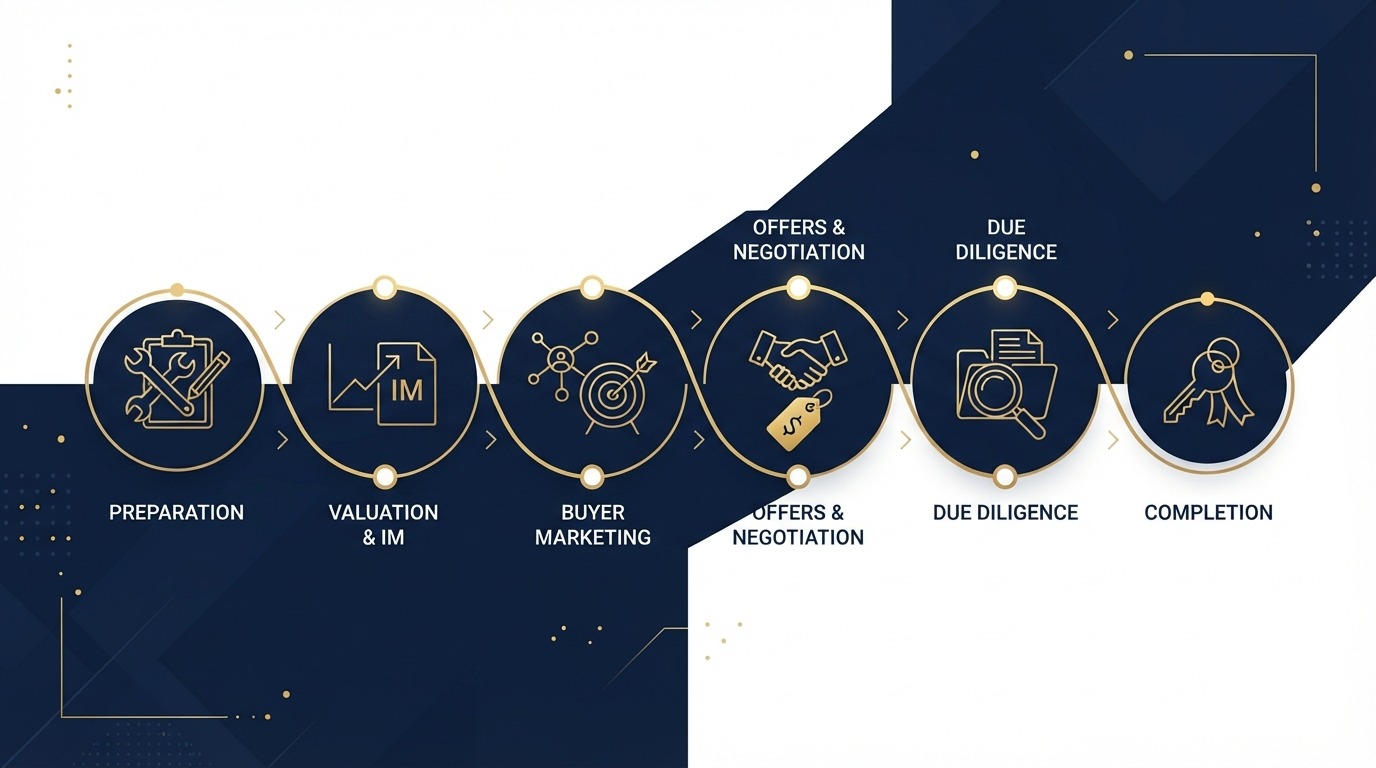
The table below sets out indicative durations for each stage of a typical mid-market sale. These are general ranges, not guarantees - every transaction has its own pace.
Stage & Indicative duration
Preparation & getting sale-ready => 1–6+ months
Valuation & Information Memorandum => 3–6 weeks
Buyer outreach & marketing => 4–8 weeks
Indicative offers & negotiation => 2–4 weeks
Due diligence => 4–8 weeks
Legal documentation & completion => 2–6 weeks
1. Preparation (1- 6+ months)
This is the most variable stage, and the one owners most often underestimate. Getting sale-ready means cleaning and normalising financials, reducing owner dependency, formalising contracts, and addressing anything a buyer will scrutinise. A business that is already well-prepared can move quickly; one that isn't may need months of work first. Our readiness checklist and exit readiness assessment show exactly what to prepare.
2. Valuation & Information Memorandum (3 - 6 weeks)
An honest valuation grounded in market evidence, followed by preparation of an investment-grade Information Memorandum, typically takes several weeks. Financial information must be gathered and normalised, and the business narrative developed and fact-checked. See our guides on how to price a business to sell and the investment memorandum.
3. Buyer outreach & marketing (4 - 8 weeks)
A confidential, targeted approach to qualified buyers - releasing information in stages - generally runs over several weeks as interested parties review the opportunity and sign confidentiality agreements. A well-prepared process with a strong buyer network moves faster here.
4. Indicative offers & negotiation (2 - 4 weeks)
Interested buyers submit non-binding indicative offers on price and structure. Reviewing these and negotiating toward a preferred offer typically takes a few weeks.
5. Due diligence (4 - 8 weeks)
The buyer verifies the claims made about the business. This should never be rushed - a hurried process is a leading cause of problems - but thorough preparation keeps it efficient and reduces the risk of renegotiation. See what due diligence really involves.
6. Legal documentation & completion (2 - 6 weeks)
Final terms are documented, agreements drafted and negotiated, funds transferred, and a transition plan implemented. The full sequence is covered in our step-by-step business sale process.
What Makes a Business Sale Faster or Slower?
Several factors move the timeline in either direction:
Preparation. The single biggest driver. A sale-ready business can move through the process far faster than one scrambling to produce information.
Clean financials. Reconciled, normalised accounts speed up both buyer interest and due diligence.
Business size and complexity. Larger, more complex businesses generally take longer.
Owner dependency and risk. Concentration and key-person issues slow buyer confidence and extend negotiation.
Deal structure. Earnouts and retained equity add negotiation complexity.
Buyer type and market conditions. A deep, motivated buyer pool and strong market shorten the process.
Quality of representation. An experienced advisor with a ready buyer network keeps momentum, as covered in why using a specialist advisor matters.
Why You Shouldn't Rush the Sale
While it's natural to want a fast sale, rushing tends to cost value. Going to market underprepared leads to weaker buyer interest, more issues surfacing in due diligence, and a stronger negotiating position for the buyer. Paradoxically, the businesses that sell fastest are usually the ones that invested time in preparation first - because a well-prepared business generates competitive tension and moves cleanly through due diligence.
Confidentiality also takes care throughout a multi-month process; our guide on how to sell a business confidentially explains how to protect the business while the sale runs.
How to Sell Your Business Faster (Without Cutting Corners)
The most reliable way to shorten the timeline is to prepare before going to market: clean and normalise your financials, reduce owner dependency, formalise contracts, and prepare a proper Information Memorandum in advance. Starting the preparation early - ideally a year or more before you intend to sell - means that when you do go to market, the process moves quickly because the hard work is already done. Our guide on building a bulletproof exit strategy explains how to plan this runway.
Blackmont Advisory helps business owners prepare properly, go to market in the strongest position, and move efficiently through to completion. As a boutique, senior-led M&A firm based in Melbourne with a global network of buyers, we keep deals moving through the inevitable friction points while protecting your outcome. For the full picture, see our complete guide to selling a business.
How long it takes to sell your business is largely within your control - and most of that control is exercised before you ever go to market.
Thinking about selling? Start with an exit readiness assessment.
Frequently Asked Questions
How long does it take to sell a business on average? Most mid-market business sales take around six to twelve months from going to market to completion, with additional preparation time beforehand. Smaller, well-prepared businesses can move faster; larger or more complex ones, or businesses that aren't sale-ready, take longer.
What is the longest part of selling a business? Preparation is usually the most variable and often the longest stage - anything from one to six months or more, depending on how sale-ready the business is. Within the active process, due diligence is typically the longest single stage, commonly four to eight weeks.
Can I sell my business quickly? A well-prepared business with clean financials and a strong buyer process can move relatively quickly, but rushing an underprepared sale usually costs value. The fastest sales are generally the best-prepared ones, because they generate competitive interest and move cleanly through due diligence.
What slows down a business sale? Poor preparation, messy or unreconciled financials, heavy customer concentration or owner dependency, complex deal structures, a thin buyer pool, and weak representation all extend the timeline. Issues discovered during due diligence are a common cause of delay.
How far in advance should I start preparing to sell? Ideally a year or more before you intend to go to market. Early preparation - cleaning up financials, reducing owner dependency, and formalising contracts - both lifts your value and shortens the eventual sale process.