

Private equity firms value businesses differently from most other buyers - not because the maths is exotic, but because of how they think about the purchase. A private equity firm is buying a business to grow it and sell it on at a profit, usually within five to seven years, often using a mix of their own capital and debt. That returns-driven, exit-focused lens shapes the multiple they'll pay. Understanding how private equity firms value a business helps you see your own business the way a PE buyer does, and negotiate from a position of knowledge.
This guide explains, in plain English, how private equity firms value a business - the method, the role of leverage and returns, and what actually moves the number.

How Do Private Equity Firms Value a Business?
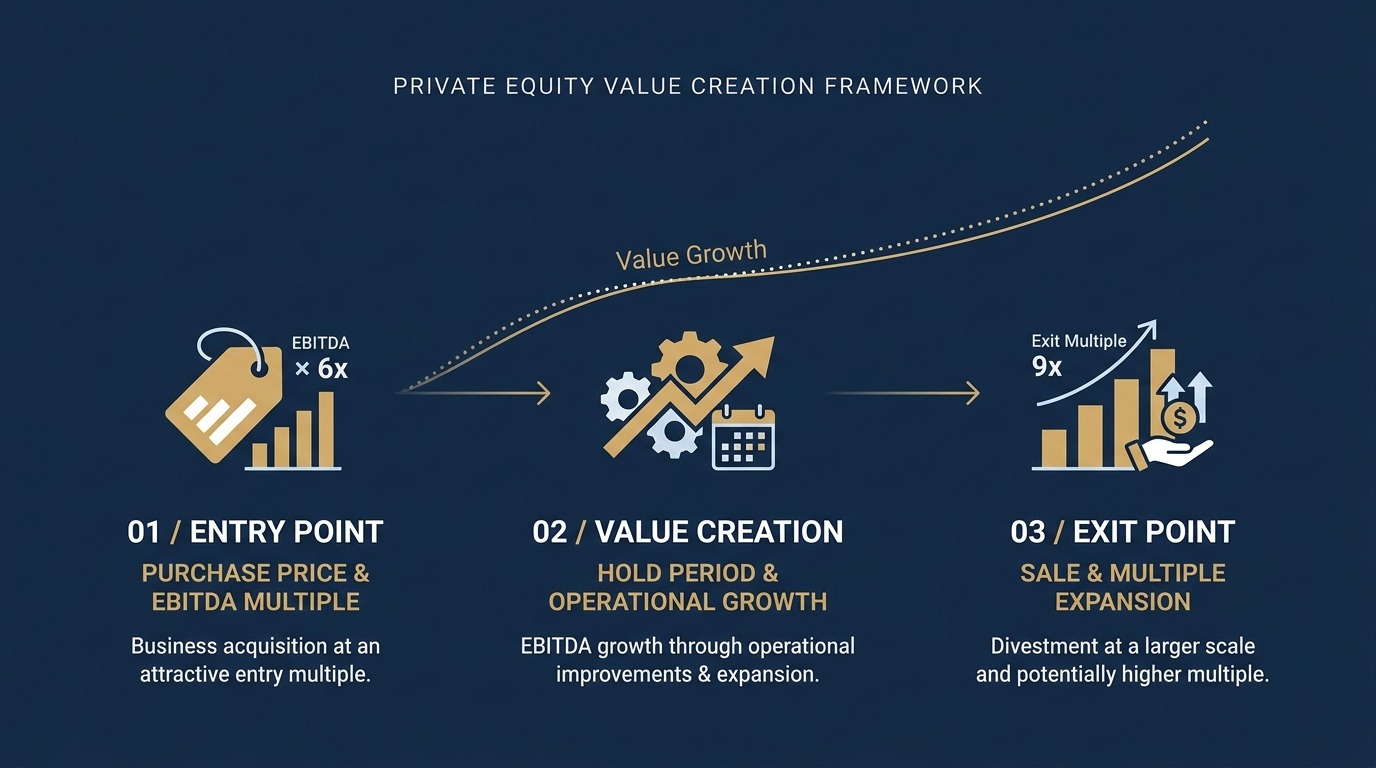
Private equity firms value a business primarily by applying a multiple to its normalised EBITDA to reach an enterprise value, then working backwards from their target return. Because PE firms buy to grow and exit, they weigh what they can pay today (the entry multiple), how they'll create value during ownership, and what they expect to sell for later (the exit multiple). Leverage - using debt alongside their own capital - amplifies those returns.
The term private equity simply means investment capital that is not publicly traded; private equity firms (also called private capital firms) pool capital from investors to buy, grow, and sell businesses. For the fundamentals, see our plain-English guide to private equity.
The Private Equity Valuation Lens
What makes a private equity valuation distinctive is not the formula - it's the mindset. Every PE valuation is anchored to a target return over a defined holding period. A PE firm asks: what can we pay today, how much can we grow earnings, what will the business be worth when we exit, and does the gap deliver our required return? That framing means a PE firm may pay a strong multiple where it sees genuine growth potential - or walk away from a good business that doesn't fit its return model. Understanding what private equity firms look for is closely tied to how they value.
The Core Method: An EBITDA Multiple
At the centre of a private equity valuation is the EBITDA multiple. The firm takes your normalised EBITDA - earnings adjusted for owner-specific and one-off items - and applies a market-derived multiple to reach an enterprise value. For example, A3millionofnormalisedEBITDAata6xentrymultipleimpliesaA18 million enterprise value, before adjusting for debt and cash.
The multiple itself depends on the sector, the size of the business, and its risk and growth profile. Our guide on EBITDA multiples by industry sets out indicative ranges, and how to price a business to sell explains normalisation in detail.
What Moves the Multiple in a PE Valuation?
From a private equity firm's perspective, the same factors that reduce risk and support growth lift the multiple they'll pay:
Recurring, predictable revenue - easier to grow and finance, so it earns a higher multiple.
Management depth beyond the owner - PE backs the team to drive growth; heavy founder reliance is a discount.
A credible growth story - because PE is buying future value, upside they can underwrite supports a stronger entry multiple.
Healthy margins and cash flow - support the debt structures PE uses and reduce risk.
A defensible market position - protects the exit value the firm is counting on.
Our readiness checklist shows how to strengthen these before going to market.
The Role of Leverage (Why PE Uses Debt)
A defining feature of private equity is the use of leverage - funding part of the purchase with debt alongside the firm's own equity. Debt amplifies returns: if the business grows and is sold for more than was paid, the equity portion earns an outsized return because part of the purchase was funded by borrowing that is repaid from the business's cash flow.
This is why cash generation and stable margins matter so much to a PE valuation - they determine how much debt the business can safely carry. It also means a PE firm's view of value is shaped not just by your earnings, but by how financeable they are.
Returns and the Exit: Valuing Backwards
Private equity firms effectively value a business backwards from their exit. They estimate what the business could be worth when they sell (the exit multiple applied to grown earnings), subtract the return they need to deliver to their investors, and arrive at what they can justify paying today. Two measures drive this: the return multiple (how many times they grow their investment) and the IRR (the annualised rate of return). A business with a credible path to higher earnings and a strong exit supports a higher price now.
This exit-focused thinking is a key difference from a family office, which invests its own capital over a longer horizon - a contrast explored in private equity vs family office.
From Enterprise Value to What You Receive
The multiple produces an enterprise value - but that is not the cash in your hand. To reach equity value (what the seller actually receives), the firm adjusts for net debt and surplus cash, and normalises working capital. The deal structure then determines how and when you're paid, often including retained equity or an earnout. Our guide on earnouts, vendor finance and deal structures explains how the headline value translates into your proceeds, and what to expect selling to private equity covers the process.
Why a PE Valuation Might Differ From Your Expectations
Because private equity values backwards from a required return, a PE firm's number can differ from what you expected - sometimes higher where they see strong, financeable growth, sometimes lower where the growth story or management depth doesn't support their model. This is not a trick; it reflects a disciplined, returns-driven process. The best way to test the market and achieve full value is a competitive process that puts several qualified buyers in play, as covered in why using a specialist advisor maximises your outcome.
Getting Full Value From a Private Equity Sale
Blackmont Advisory helps business owners understand how buyers value their business, prepare to present it at its strongest, and run a competitive process that drives price and terms. As a boutique, senior-led M&A firm based in Melbourne with a global network of private equity firms, family offices and strategic buyers, we establish a defensible valuation and negotiate to protect your outcome. Start with an honest confidential valuation, benchmark against your sector data, or read our complete guide to selling a business.
Understanding how private equity firms value a business turns a mysterious number into something you can anticipate, prepare for, and influence.
Want to know what your business is worth? Start with a confidential valuation.
Frequently Asked Questions
How do private equity firms value a business? Private equity firms apply a multiple to normalised EBITDA to reach an enterprise value, then test it against a target return over a five-to-seven-year hold. They weigh what they can pay today (the entry multiple), the value they can create during ownership, and what they expect to sell for at exit, using leverage to amplify returns.
What multiple do private equity firms pay? It varies by sector, business size, growth, and risk. The entry multiple is drawn from comparable transactions and the firm's return model. Higher multiples go to businesses with recurring revenue, management depth, strong margins, and a credible, financeable growth story.
What is EBITDA and why do private equity firms focus on it? EBITDA is earnings before interest, tax, depreciation and amortisation - an approximation of a business's underlying cash earnings. Private equity firms focus on normalised EBITDA because it reflects sustainable earning power, drives the multiple, and indicates how much debt the business can support.
Why do private equity firms use debt to buy businesses? Debt (leverage) amplifies returns. By funding part of the purchase with borrowing repaid from the business's cash flow, the firm's equity earns an outsized return if the business grows and is sold for more. This is why stable cash flow and margins strongly influence a PE valuation.
Will a private equity firm pay more than other buyers? Sometimes. A PE firm may pay a premium where it sees strong, financeable growth that fits its return model - or less where the growth story doesn't. The most reliable way to achieve full value from any buyer is a competitive sale process.