
How to Buy a Business in Australia: Costs, Steps and Financing
Buying an established business is one of the fastest routes to ownership in Australia, but many first-time buyers focus only on the purchase price and are surprised by the full cost and funding required. The price on the listing is rarely the whole story. There is working capital to fund, professional fees to budget for, and a financing structure to put in place. Understanding the real costs of buying a business, and how to finance them, is essential to a successful acquisition.
This guide explains how to buy a business in Australia with a clear focus on the money: the steps involved, the true costs beyond the headline price, and the financing options available to fund a purchase.

How Do You Buy a Business in Australia?
To buy a business in Australia, you define what you want, find and assess opportunities, value the business, conduct due diligence, negotiate price and structure, arrange financing, and complete the purchase with legal agreements and a transition plan. Alongside the purchase price, budget for working capital, professional fees, due diligence, and any transfer duties, and arrange your full funding before you commit.
The steps are summarised below. For the complete process, see our step-by-step guide to buying a business and our guide to buying a business in Australia. This article focuses on what it costs and how to fund it.
The Steps to Buy a Business (In Brief)
While every acquisition differs, a typical purchase follows a consistent sequence: defining your acquisition brief, finding opportunities (including off-market ones), assessing and valuing the business, conducting due diligence, negotiating price and structure, arranging finance, and completing the transaction. Our guides on how to find a business to buy and the step-by-step acquisition process cover these in full. The rest of this guide concentrates on the costs and financing, which is where buyers most often get caught out.
How Much Does It Cost to Buy a Business?
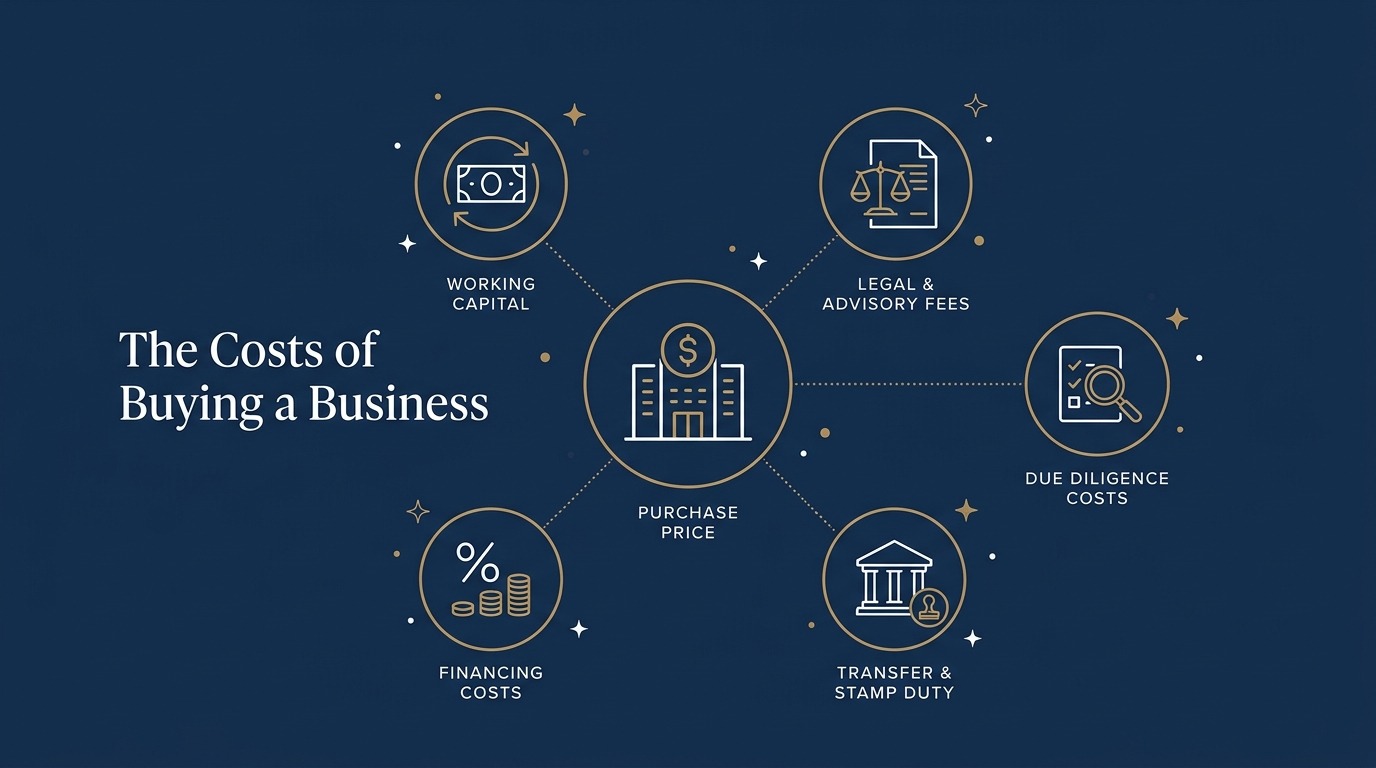
The cost of buying a business is more than the purchase price. A realistic budget includes several components:
The purchase price. Usually based on a multiple of normalised earnings, cross-checked against comparable transactions. Understanding how this is calculated protects you from overpaying. See our guides on how much a business is worth and EBITDA multiples by industry.
Working capital. One of the most commonly overlooked costs. You need enough cash to run the business from day one, covering wages, suppliers, and operating expenses before the business generates its own cash flow. Underestimating this is a frequent and serious mistake.
Professional and advisory fees. Legal, accounting, and advisory fees to assess, structure, and complete the purchase properly. These protect you from far more expensive mistakes.
Due diligence costs. The cost of verifying the business through financial, legal, and other reviews before you commit. Our due diligence checklist for buyers sets out what this involves.
Transfer duties and government costs. Depending on how the deal is structured and which state the business is in, transfer or stamp duty and other government charges may apply. These vary by state and by deal structure, so confirm them with your adviser.
Financing costs. If you borrow to fund the purchase, factor in interest and establishment costs over the life of the loan.
The key lesson is to budget for the total funding requirement, not just the asking price. Going in underfunded is one of the most common causes of early difficulty for new owners.
How to Finance Buying a Business in Australia
Few buyers fund an acquisition entirely from their own cash. Most use a combination of the following:
Your own equity (cash). The capital you contribute directly. Lenders and sellers generally expect a meaningful equity contribution from the buyer.
Bank or acquisition finance. Banks and lenders may fund part of a business purchase, typically where the business has stable, demonstrable cash flow to service the debt. The amount available depends on the business, the security offered, and the lender's assessment.
Vendor finance. The seller allows part of the price to be paid over an agreed period after completion, effectively financing part of the sale. This reduces your upfront capital requirement and can signal the seller's confidence in the business.
Earnouts. Part of the price is tied to the business achieving agreed performance after completion, which can reduce your upfront outlay and align risk between you and the seller.
Private investors or partners. Bringing in co-investors or partners to contribute capital in exchange for equity.
Each option has different implications for risk, control, and cost. Our guide on how to finance a business acquisition explains the structures in detail, and our guide on earnouts, vendor finance and deal structures covers how deferred structures work in practice.
How Much Deposit or Equity Do You Need?
There is no single fixed figure, because it depends on the business, the lender, and the structure of the deal. Lenders and sellers generally expect the buyer to contribute a meaningful portion of the purchase from their own funds, with the balance funded through a combination of finance and, often, vendor terms. The stronger and more stable the business's cash flow, the more financing it can typically support. The best approach is to understand your realistic borrowing capacity and total funding position before you start seriously pursuing opportunities, so you only pursue deals you can actually fund.
Common Costing and Financing Mistakes
A few mistakes catch buyers repeatedly. Focusing only on the purchase price and forgetting working capital is the most common, and can leave a new owner short of cash from day one. Underestimating professional and due diligence costs, and trying to save money by skipping proper advice, often proves far more expensive later. Arranging financing too late, after agreeing terms rather than before, weakens your position. And overpaying because the valuation was not properly understood undermines the whole acquisition. Our guide on common first-time buyer mistakes covers these and more.
Getting Help to Buy a Business
Buying a business, particularly for the first time, is far easier and safer with experienced guidance. A specialist buy-side advisor helps you source and assess opportunities, apply valuation discipline so you do not overpay, structure the funding, and negotiate terms that protect you.
Blackmont Advisory acts as an exclusive buyer advocate for acquirers, including first-time buyers, across Australia. As a boutique, senior led M&A firm based in Melbourne with a global network, we work exclusively for you, never both sides of the same deal, helping you find the right business and structure a purchase you can fund with confidence. See our complete guide to buying a business and our buyer's checklist for more.
Buying a business in Australia is a genuine opportunity, provided you understand the full cost, arrange your financing properly, and avoid the traps that catch underprepared buyers.
Ready to buy a business? Register your acquisition brief.
This article provides general information about the costs and financing of buying a business and is not personal financial, tax, or legal advice. Costs such as transfer duties vary by state and circumstances. Speak with a qualified adviser about your specific situation.
Frequently Asked Questions
How much does it cost to buy a business in Australia? The cost is more than the purchase price. A realistic budget includes the price (usually a multiple of normalised earnings), working capital to run the business from day one, legal, accounting and advisory fees, due diligence costs, any transfer or stamp duty depending on structure and state, and financing costs. Always budget for the total funding requirement, not just the asking price.
How do I finance buying a business in Australia? Most buyers use a combination of their own equity, bank or acquisition finance, vendor finance, earnouts, and sometimes private investors or partners. The right mix depends on the business's cash flow, the security available, and your own position. Arrange your financing before you seriously pursue opportunities.
How much deposit do I need to buy a business? There is no single fixed figure. Lenders and sellers generally expect a meaningful equity contribution from the buyer, with the balance funded through finance and often vendor terms. The stronger the business's cash flow, the more financing it can typically support. Understand your realistic funding position before you start.
What costs do first-time buyers forget? Working capital is the most commonly overlooked cost, leaving new owners short of cash from day one. Buyers also underestimate professional and due diligence fees, and sometimes try to save money by skipping proper advice, which usually proves more expensive later.
What are the steps to buy a business in Australia? Define your acquisition brief, find and assess opportunities, value the business, conduct due diligence, negotiate price and structure, arrange financing, and complete the purchase with legal agreements and a transition plan. Each stage benefits from experienced guidance, particularly for first-time buyers.
Can I buy a business with vendor finance? Yes. Vendor finance, where the seller allows part of the price to be paid over an agreed period after completion, is a common way to reduce the upfront capital required. It can also signal the seller's confidence in the business, though the terms and any security should be clearly documented.