

Selling a business is, for most owners, the largest single financial event of their life. The proceeds often represent decades of work, and how they are managed will shape your financial security for the rest of your life. That is why choosing the right independent financial advisor, well before you sell, is one of the most important decisions you will make around your exit. The wrong advisor, or no advisor at all, can quietly cost you far more than their fee. The right one helps protect and grow what you have built.
This guide explains how to choose an independent financial advisor before selling your business: what an independent advisor actually is, why independence matters so much at this stage, what to look for, the questions to ask, how fees work, and the red flags to avoid. It is written for owners approaching a significant liquidity event, not for everyday financial planning.

How Do You Choose an Independent Financial Advisor?
To choose an independent financial advisor before selling your business, look for genuine independence from product providers, direct experience with clients who have sold businesses, appropriate licensing and qualifications, a transparent fee structure, and a willingness to work alongside your mergers and acquisitions advisor. Interview more than one, ask direct questions about conflicts and fees, and choose someone whose advice is clearly aligned with your interests rather than a parent institution's products.
The sections below set out each of these considerations in detail. For the broader picture of what a specialist advisor actually does at this stage, see our companion guide on what a high net worth financial advisor does when you sell a business.
Why Choosing the Right Advisor Matters When Selling a Business
Most financial advisors work with clients who are building wealth gradually, through salary, superannuation, and steady investment. Selling a business is a very different situation. It creates a single, large capital event that instantly transforms your financial position, often after years where the majority of your net worth sat inside one illiquid asset.
This shift brings challenges that a generalist advisor may not be equipped to handle well. How do you deploy a large lump sum without concentrating risk in the wrong places? How should the proceeds be structured for tax efficiency, given the specific circumstances of your sale? What does a realistic long term income plan look like once the business is no longer generating your primary income? These are specialist questions, and the advisor you choose needs genuine experience answering them. Planning for them early is central to a strong exit, as covered in our guide on building a bulletproof exit strategy.
What Is an Independent Financial Advisor?
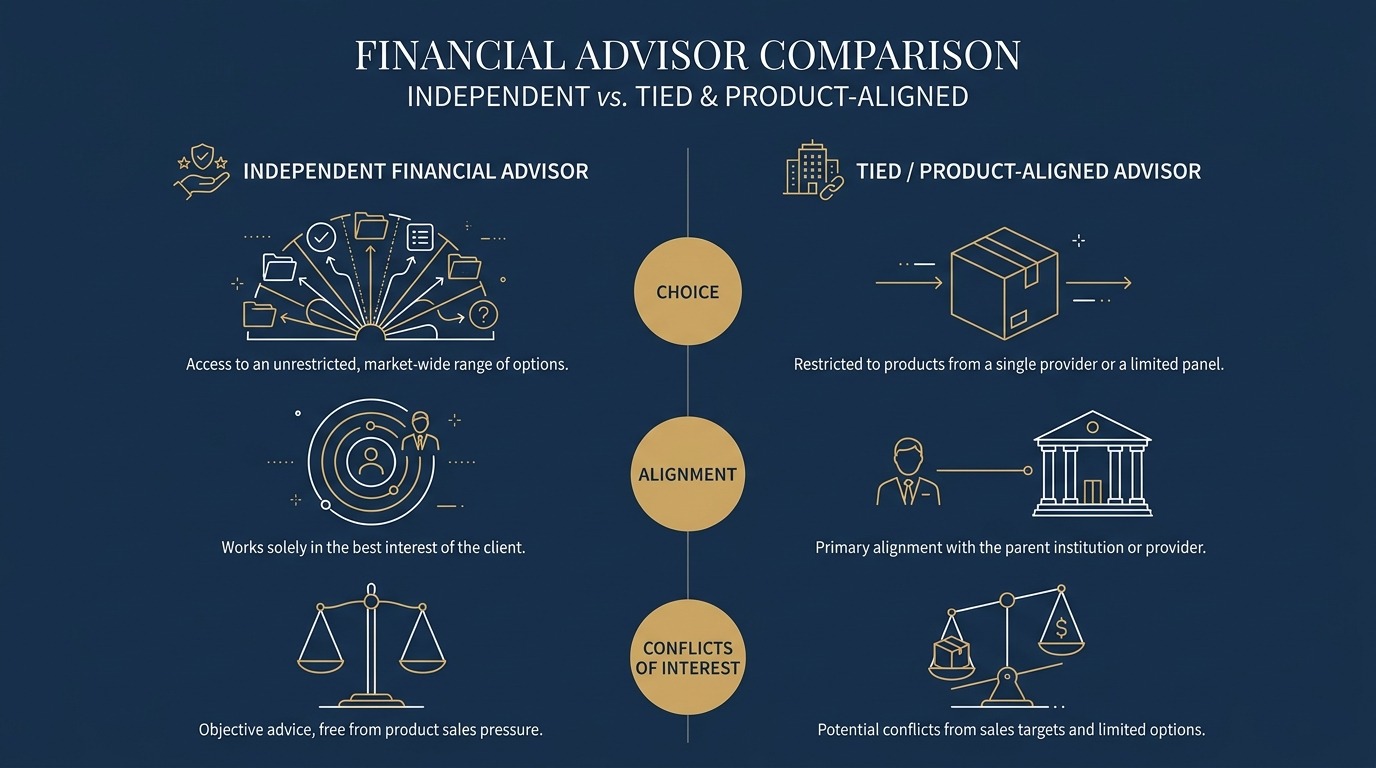
An independent financial advisor is one whose advice is not tied to, or incentivised by, a particular institution's products. They are generally free to recommend solutions based on what suits your circumstances, rather than being steered toward a parent company's investment products or targets.
This stands in contrast to advisors attached to a larger institution, such as a bank or product provider, who may face pressure, direct or indirect, to recommend in-house products. The distinction is not always obvious from the outside, which is one reason it is worth asking directly. Given the scale of the wealth involved in a business sale, the difference in whose interests the advice genuinely serves can be very significant.
Why Independence Matters So Much at This Stage
When you are investing the proceeds of a lifetime's work, you want advice that is structured around your goals, not around selling you a product. An independent advisor is more likely to give you that, because their recommendations are not constrained by a limited menu of proprietary products or by incentives to favour them.
Independence also tends to come with a broader view. An independent advisor can usually consider a wider range of strategies, providers, and structures, and can be more candid about what is genuinely in your interest, including advice to do nothing, wait, or diversify in ways that a product-aligned advisor might be less inclined to suggest. At the scale of a business sale, that breadth and candour are worth a great deal.
When to Engage a Financial Advisor in the Sale Process
One of the most common and costly mistakes owners make is waiting until after settlement to think seriously about wealth management. In reality, the financial and tax planning decisions made before the sale, particularly those around deal structure, can materially affect the after tax proceeds you actually receive.
Engaging an independent financial advisor early, ideally alongside your mergers and acquisitions advisor, means these considerations can be built into the deal structure itself. For example, the choice between a full cash payment and a structure involving vendor finance or an earnout can have very different tax and cash flow implications. It is far easier to plan for this before terms are agreed than to react to it afterward. Our guide on earnouts, vendor finance and deal structures explains how these choices affect what you keep.
What to Look For When Choosing an Independent Financial Advisor
When evaluating advisors for this stage of your life, several qualities matter more than others:
Genuine independence. Confirm the advisor is not incentivised to recommend particular products, and understand who, if anyone, they are affiliated with.
Experience with business sale clients. Ask whether they have worked with clients who recently sold a business, as opposed to clients who accumulated wealth gradually. A liquidity event is a specialist situation.
Appropriate licensing and qualifications. In Australia, financial advisers must be appropriately licensed and listed on the official register of advisers. Confirm the advisor's credentials and standing before you engage them.
A transparent fee structure. You should be able to understand exactly how the advisor is paid, and whether they receive any commissions or incentives tied to specific products.
Strength in tax and estate planning. Post sale wealth often involves tax structuring, estate planning, and succession considerations. Make sure the advisor has genuine capability here, or works closely with those who do.
A collaborative approach. The best outcomes come when your financial advisor and your mergers and acquisitions advisor communicate throughout the process. Choose someone willing to work as part of a team.
A clear, understandable strategy. You should finish an initial meeting understanding how the advisor thinks, not more confused than when you started.
Our exit planning approach is designed to bring these considerations together early, in parallel with the sale itself.
Questions to Ask Before You Choose
A short, direct conversation reveals a great deal. Before choosing an independent financial advisor, consider asking:
Are you independent, and are you incentivised to recommend any particular products?
How are you paid, and are there any commissions or product-linked incentives?
Have you worked with clients who have recently sold a business?
How would you approach structuring and investing proceeds from a business sale?
How do you handle tax and estate planning, and do you work with specialists?
Will you work alongside my mergers and acquisitions advisor during the sale?
What does a realistic long term income plan look like for someone in my position?
Can you provide references from clients in a similar situation?
The answers, and how directly they are given, tell you a lot about whether the advisor is the right fit.
Understanding Fee Structures
How an advisor is paid shapes the advice they give, so it is worth understanding the common models. Some advisors charge flat or fixed fees for advice, which keeps their recommendations separate from any product. Some charge a percentage of the assets they manage for you, which aligns their interest with growing your wealth but is worth understanding clearly at the scale of a business sale. Others receive commissions or incentives linked to particular products, which is the model most likely to create a conflict of interest.
None of these is automatically wrong, but you should know which model applies, what it will cost in real terms, and whether it creates any incentive that could influence the advice. Transparency here is itself a good sign.
Red Flags to Avoid
Some warning signs are worth taking seriously. Be cautious of an advisor who is vague or evasive about how they are paid, who pushes specific products early without first understanding your situation, who cannot demonstrate experience with business sale clients, or who discourages you from seeking independent tax or legal input. Pressure to make quick decisions, or reluctance to put recommendations and their basis in writing, are also reasons to pause. At this scale, you are entitled to clarity, patience, and advice that is demonstrably in your interest.
How Your Financial Advisor Works Alongside Your M&A Advisor
It is important to understand that an independent financial advisor and your business sale advisor serve different, complementary purposes. Your mergers and acquisitions advisor manages the transaction itself, including buyer identification, negotiation, deal structuring from the business's perspective, and coordination through to settlement. Your financial advisor focuses on what happens to the proceeds once they reach you, and how to structure your broader financial life around your new position.
The strongest outcomes tend to occur when these two advisors are introduced early and communicate throughout the process. This ensures the deal structure agreed with the buyer also serves your personal financial objectives, rather than the two processes running in isolation. Our guide on why specialist representation matters explains the value of experienced advice on the transaction side.
Bringing the Right Advisors to the Table
Blackmont Advisory works exclusively on the business sale process itself, structuring transactions, managing buyer relationships, and negotiating terms that protect our clients' outcomes. As a senior led advisory firm based in Melbourne, we regularly work alongside our clients' independent financial and tax advisors throughout a sale, ensuring deal structure decisions reflect both the commercial realities of the transaction and each seller's broader financial planning objectives. For the wider picture of a well run sale, see our complete guide to selling a business, and to understand what your business might realistically achieve, start with a confidential valuation.
Choosing the right independent financial advisor is not a task for after settlement. Done early, in parallel with your sale, it is one of the clearest ways to ensure the wealth you have created translates into lasting financial security.
Planning your exit? Start with our exit planning approach.
This article provides general information about choosing a financial advisor and is not personal financial, tax, or legal advice. Speak with a qualified, independent, appropriately licensed advisor about your specific circumstances.
Frequently Asked Questions
What is an independent financial advisor? An independent financial advisor is one whose advice is not tied to, or incentivised by, a particular institution's products. They are generally free to recommend solutions based on your circumstances rather than being steered toward a parent company's investment products or targets, which is why independence matters so much when investing the proceeds of a business sale.
Why is independence important when choosing a financial advisor? Because you want advice structured around your goals, not around selling you a product. An independent advisor can usually consider a wider range of strategies and providers, and can be more candid about what genuinely serves your interests. At the scale of a business sale, that breadth and candour can make a significant difference to your outcome.
When should I engage a financial advisor before selling my business? Early, ideally alongside your mergers and acquisitions advisor and before terms are agreed. Planning decisions made before the sale, particularly those around deal structure, can materially affect your after tax proceeds, so it is far easier to plan ahead than to react after settlement.
What questions should I ask a financial advisor before choosing one? Ask whether they are independent and how they are paid, whether they have worked with clients who recently sold a business, how they would structure and invest the proceeds, how they handle tax and estate planning, and whether they will work alongside your M&A advisor. How directly they answer tells you a great deal.
How do financial advisors charge fees? Common models include flat or fixed fees for advice, a percentage of the assets they manage, or commissions linked to particular products. None is automatically wrong, but you should understand which model applies, what it costs in real terms, and whether it creates any incentive that could influence the advice.