
"How much is my business worth?" is the question almost every owner asks before they consider selling, and the honest answer is that it depends on how you value it, who is buying, and how well the business is prepared. There is no single magic number. Instead, experienced advisors apply several established valuation methods, cross-check them against real market evidence, and arrive at a defensible range. Understanding those methods puts you in a far stronger position, whether you are years from selling or ready to go to market now.
This guide explains, in plain terms, how much your business might be worth: the main business valuation methods, what drives the number up or down, why an industry rule of thumb is not a real valuation, and how to get an accurate figure you can rely on.

How Do You Work Out How Much a Business Is Worth?
You work out how much a business is worth by normalising its earnings, then applying one or more valuation methods, most commonly an earnings multiple, cross-checked against comparable transactions and current buyer appetite. Credible valuation triangulates across more than one method rather than relying on a single calculation, and adjusts for the specific size, risk, and growth profile of the business.
The main methods are explained below. For the strategy of pricing a business for sale, see our guide on how to price a business to sell, and for an honest figure for your own business, a confidential valuation is the place to start.
Why There Is No Single "Right" Number
A valuation is a judgement, not a fixed fact. The same business can be worth different amounts to different buyers, at different times, depending on strategic fit, market conditions, and how the sale process is run. A private equity firm pursuing a specific growth thesis may value a business differently from a family office or a strategic competitor. This is why credible valuation produces a defensible range grounded in evidence, rather than a single precise figure, and why the way you take the business to market materially affects the price you achieve.
The Foundation: Normalised Earnings
Before any valuation method can be applied sensibly, your earnings need to be normalised. Normalised earnings are your reported profits adjusted for items that would not carry forward to a new owner, such as above market owner salaries, personal expenses run through the business, one off legal costs, or non recurring revenue. For larger businesses this figure is usually normalised EBITDA (earnings before interest, tax, depreciation and amortisation). For smaller, owner operated businesses it is often SDE (seller's discretionary earnings), which adds back the owner's salary and benefits.
Getting this base right is critical, because every earnings based method applies a multiple to it. An unreliable earnings figure produces an unreliable valuation, which is why buyers scrutinise it closely during due diligence.
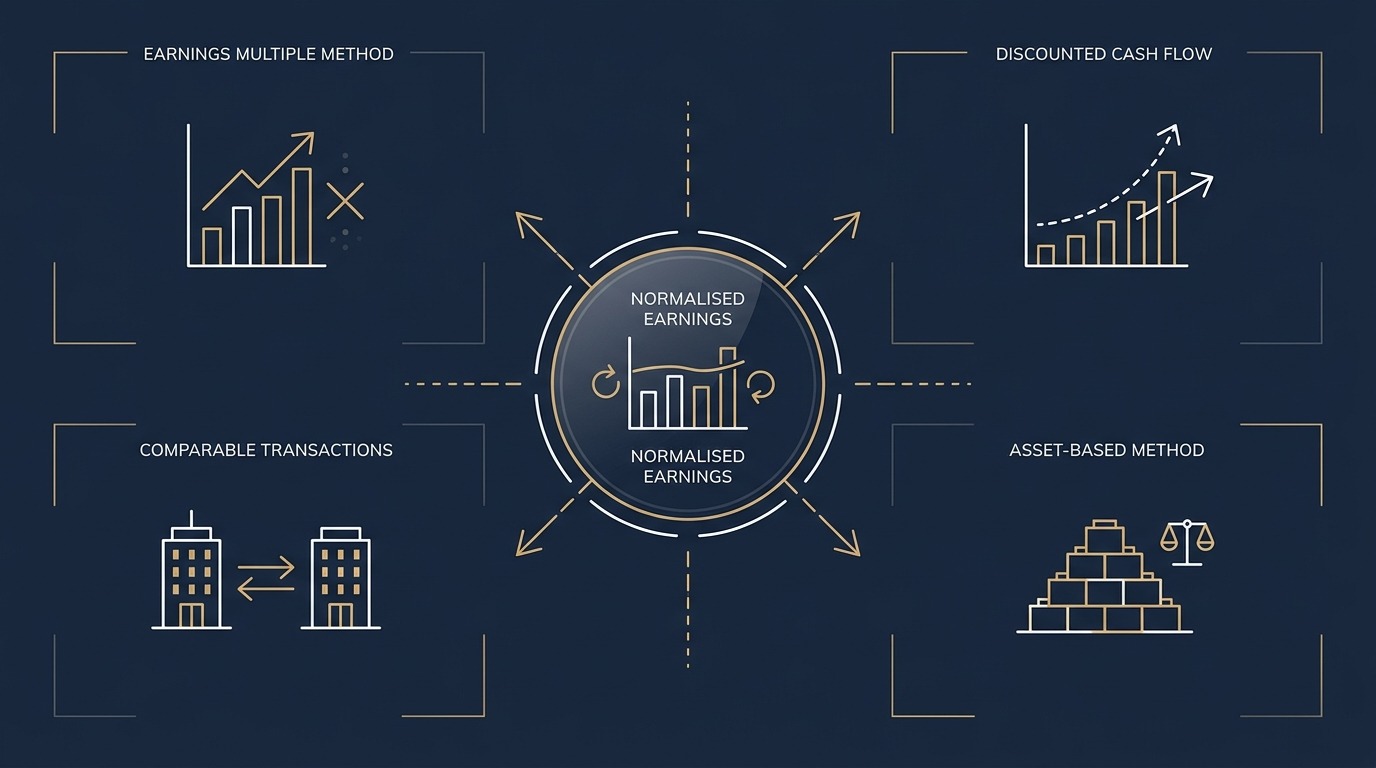
The Main Business Valuation Methods
Most credible valuations draw on several of the following methods and reconcile them.
1. Earnings multiple method
The most common approach applies a multiple to normalised earnings, usually EBITDA. For example, a business with normalised EBITDA of one million dollars valued at a 5x multiple has an indicative enterprise value of five million dollars, before balance sheet adjustments. The multiple itself varies by industry, business size, growth, and risk, and this is where much of the real judgement sits. Our guide on EBITDA multiples by industry sets out indicative ranges and what moves them.
When it is used: most profitable, established businesses. Strength: simple, grounded in real earnings and market multiples. Limitation: the multiple must be well chosen and the earnings properly normalised, or the result is misleading.
2. Discounted cash flow (DCF)
This method projects the business's future cash flows and discounts them back to a present value, reflecting both expected growth and risk. It is more relevant for businesses with strong, predictable, and well-evidenced growth trajectories.
When it is used: businesses with reliable forecasts and clear growth. Strength: captures future potential, not just current earnings. Limitation: highly sensitive to the assumptions used, so a small change in inputs can produce a very different number.
3. Comparable transactions method
This approach looks at recent, genuinely comparable sales in the same or an adjacent industry to anchor what buyers are actually willing to pay right now. It provides a real-world check against theoretical models.
When it is used: as a cross-check on other methods, and where good comparable data exists. Strength: grounded in what the market is actually paying. Limitation: truly comparable transactions can be hard to find, and private deal data is not always available.
4. Asset-based method
For asset-heavy businesses, or those in distress, the value of the underlying assets may be more relevant than an earnings multiple. This method values the business based on its net assets.
When it is used: asset-heavy businesses (such as manufacturing), or where earnings are volatile or negative. Strength: reflects tangible underlying value. Limitation: ignores the earning power and goodwill of a healthy trading business, so it often understates a profitable going concern.
5. Market approach for smaller businesses (SDE)
For smaller, owner-operated businesses, buyers often apply a multiple to SDE rather than EBITDA. The multiples are lower, reflecting the greater reliance on the owner. Applying an EBITDA multiple to an SDE figure, or the reverse, is a common and serious error, because the earnings basis must match the multiple.
Triangulating to a Defensible Range
In practice, a credible valuation does not rely on a single method. An advisor will typically apply an earnings multiple, cross-check it against comparable transactions, consider a DCF where forecasts support it, and reconcile these into a defensible range. Where the methods broadly agree, confidence is high. Where they diverge, the reasons are worth understanding before going to market.
What Affects How Much Your Business Is Worth
Two businesses with identical earnings can be worth very different amounts, because buyers price in qualitative factors:
Recurring revenue. Contracted or subscription revenue is valued more highly than one-off income.
Customer concentration. Heavy reliance on one or two customers reduces value.
Management depth. A business that runs without the owner is worth more than one that depends on them.
Growth trajectory. Consistent, credible growth supports a higher multiple.
Margin quality. Higher-margin, less capital-intensive businesses tend to command more.
Clean financials. Numbers that withstand scrutiny protect the valuation.
Most of these can be strengthened before a sale. Our readiness checklist shows exactly what to improve, and you can benchmark against sector data using our industry benchmarks.
Why an Industry Rule of Thumb Is Not a Valuation
It is tempting to take an industry multiple from a chart, multiply it by your earnings, and treat the result as your valuation. This is a mistake. Rules of thumb ignore the specific size, risk, growth, and earnings quality of your business, and many widely shared multiples come from markets or deal sizes that do not reflect the Australian mid market. A rule of thumb is useful context, not a valuation. The real number depends on your business's specifics and how it is taken to market.
Why Valuations Differ Between Buyers
The same business can be valued differently by different buyers. A strategic competitor may pay a premium for synergy. A private equity firm values with a target return and exit in mind, as explained in our guide on how private equity firms value a business. A family office may value long-term stability. This is exactly why a competitive sale process matters: putting several qualified buyers in competition is the most reliable way to discover the strongest price, as covered in why using a specialist advisor maximises your outcome.
Common Valuation Mistakes to Avoid
A few errors recur often. Valuing on revenue rather than normalised earnings overstates the number. Applying a multiple to the wrong earnings basis (EBITDA versus SDE) produces a wildly inaccurate figure. Relying on a single method, or a single industry rule of thumb, gives false confidence. Overstating growth without evidence inflates a figure that will not survive due diligence. And anchoring to an inflated number early makes every later negotiation harder. Avoiding these is part of why an honest, evidence-based valuation is so valuable.
How to Get an Accurate Valuation
Blackmont Advisory provides business owners with honest valuation guidance grounded in current market appetite and genuinely comparable evidence, not a figure designed to win a mandate. As a boutique, senior led M&A firm based in Melbourne with a global network of buyers, we assess your normalised earnings, apply and reconcile the appropriate methods, and identify the specific steps that would improve your number before you go to market. To understand what your business might realistically achieve, start with a confidential valuation, or read our complete guide to selling a business.
Knowing how much your business is worth is not about finding one perfect number. It is about understanding the methods, the factors that drive the figure, and how to position your business so the market rewards it fully.
Want to know what your business is worth? Start with a confidential valuation.
This article provides general information about business valuation methods and is not a valuation or personal financial advice. Figures and multiples vary with market conditions and business-specific factors. Speak with a qualified advisor about your specific circumstances.
Frequently Asked Questions
How do I work out how much my business is worth? Normalise your earnings, then apply one or more valuation methods, most commonly an earnings multiple, and cross-check against comparable transactions and current buyer appetite. Credible valuation triangulates across more than one method and adjusts for your business's size, risk, and growth, producing a defensible range rather than a single number.
What are the main business valuation methods? The main methods are the earnings multiple approach (usually applied to EBITDA), discounted cash flow, comparable transactions, and the asset-based approach. For smaller owner-operated businesses, a multiple is often applied to seller's discretionary earnings (SDE) instead of EBITDA. Most credible valuations reconcile several methods.
What is the most common way to value a business? The earnings multiple method is the most common. It applies a market-derived multiple to normalised earnings (usually EBITDA) to estimate enterprise value. The multiple varies by industry, size, growth, and risk, and the earnings must be properly normalised for the result to be reliable.
Can I value my business using an industry multiple? An industry multiple is useful context but not a full valuation. It ignores your business's specific size, risk, growth, and earnings quality, and many shared multiples come from markets or deal sizes that do not reflect the Australian mid market. Use it as a starting point, not a final figure.
Why do different buyers value my business differently? Because each buyer values with their own lens. A strategic competitor may pay for synergy, a private equity firm values with a target return and exit in mind, and a family office may value long-term stability. A competitive process that puts several qualified buyers in play is the most reliable way to discover the strongest price.
What increases the value of my business? Recurring revenue, a diversified customer base, management depth beyond the owner, consistent and credible growth, healthy margins, and clean, verifiable financials. These reduce buyer risk and support a higher multiple. Most can be strengthened before going to market.