

Selling a manufacturing business in Australia is different from selling most other businesses. Manufacturers carry plant and equipment, inventory and work in progress, complex customer and supplier contracts, skilled staff, and compliance obligations that all have to be understood, presented, and defended in a sale. Get the preparation right and a manufacturing business can attract strong interest from strategic buyers, private equity, and family offices. Get it wrong and value leaks at every stage.
This guide explains how to sell a manufacturing business in Australia - how these businesses are valued, who the buyers are, what lifts (or suppresses) your price, and how to prepare properly before going to market.

How Do You Sell a Manufacturing Business in Australia?
To sell a manufacturing business in Australia, you prepare clean, normalised financials, document your plant, contracts and processes, reduce reliance on the owner, then run a confidential, competitive sale process that puts qualified strategic buyers, private equity firms and family offices in front of your business. Preparation is what protects the price; a well-run process is what maximises it.
The steps below walk through valuation, buyers, value drivers, and preparation specific to manufacturers. For the broader framework, see our complete guide to selling a business and our dedicated selling a manufacturing business page.
How Are Manufacturing Businesses Valued?
Manufacturing businesses are typically valued on a multiple of normalised EBITDA, cross-checked against the value of plant, equipment and inventory. In the Australian mid market, manufacturers broadly trade in an indicative range of around 4x to 7x normalised EBITDA, though the actual figure depends heavily on earnings quality, customer diversification, and how capital-intensive the business is.
Two things matter most. First, your normalised earnings - reported profit adjusted for owner-specific and one-off items, which is the base any multiple is applied to. Second, your asset base - because manufacturers hold significant plant, equipment, and inventory, buyers weigh both earnings and the condition and value of those assets. Aging equipment that will need replacing (future capital expenditure) can weigh on the multiple; modern, well-maintained or automated plant can lift it.
Because this is nuanced, an indicative range is only a starting point. Our guides on how to price a business to sell and a confidential valuation establish a defensible number, and our industry benchmarks show where your sector sits.
Who Buys Manufacturing Businesses in Australia?
Manufacturing businesses attract three main buyer types: strategic (trade) buyers already in the sector, private equity firms, and family offices.
Strategic / trade buyers - competitors, suppliers, or customers seeking scale, capability, capacity, or vertical integration. They often pay a premium where there is genuine synergy.
Private equity firms - attracted to manufacturers with recurring or contracted revenue, defensible positions, and room to grow through operational improvement or add-on acquisitions. Our private equity guide explains how they operate.
Family offices - increasingly active in Australian mid-market manufacturing, valuing stable, long-term businesses they can own outright, as covered in our guide to family offices in Australia.
The strongest price usually comes from putting several of these buyers in competition through a confidential process, rather than negotiating with a single approach.
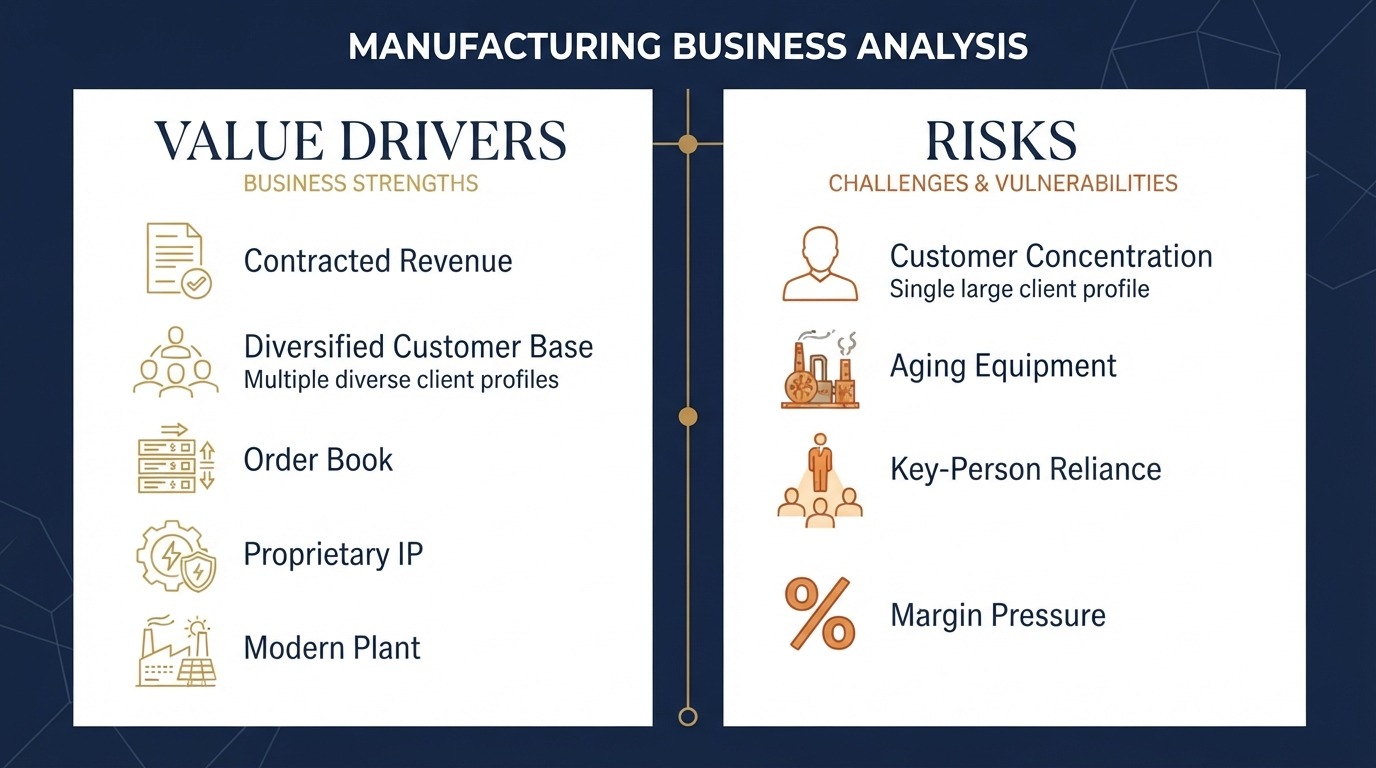
What Lifts the Value of a Manufacturing Business?
Two manufacturers with the same EBITDA can sell for very different prices. The factors that lift a manufacturing business's value include:
Contracted or recurring revenue - long-term supply agreements and repeat orders are valued far more highly than one-off project work.
A diversified customer base - heavy reliance on one or two customers is one of the biggest value risks in manufacturing; diversification reduces it.
A strong, visible order book - forward orders give buyers confidence in future earnings.
Proprietary products, IP, or specialised capability - anything that is hard for a competitor to replicate supports a premium.
Modern, well-maintained or automated plant - reduces the buyer's future capital expenditure and key-person reliance.
Management depth beyond the owner - a business that runs without the founder commands more than one that depends on them.
Clean margins and disciplined working capital - well-managed inventory and margins signal a well-run operation.
Most of these can be strengthened before you go to market. Our readiness checklist and exit readiness assessment show exactly what to improve.
What Risks Do Buyers Scrutinise in a Manufacturing Sale?
Buyers of manufacturing businesses look hard at specific risks: customer concentration, aging or under-maintained equipment, key-person dependency, margin pressure from input costs or offshore competition, and any workplace-safety or environmental liabilities. Undisclosed issues in these areas are a common trigger for price renegotiation during due diligence.
The best defence is thorough preparation - surfacing and addressing these issues proactively rather than letting a buyer discover them. Our guides on what due diligence really involves and the ultimate due diligence guide show what buyers will test.
How to Prepare a Manufacturing Business for Sale
Preparation is where manufacturing sales are won or lost. Before going to market:
Clean and normalise your financials - three to five years of reconciled statements, with owner-specific and one-off items clearly documented.
Document your plant and equipment - an up-to-date asset register, maintenance records, and a clear view of upcoming capital expenditure.
Formalise contracts - customer supply agreements, key supplier terms, and employment arrangements documented rather than informal.
Diversify and de-risk revenue - where possible, reduce dependence on any single customer.
Reduce owner dependency - document processes and build a second tier of management.
Get compliance in order - workplace safety, environmental, and regulatory obligations current and documented.
Prepare an investment-grade Information Memorandum - presenting the business, its assets, and its earnings credibly to buyers. See our guide on the investment memorandum.
This preparation, done properly before you go to market, is one of the most valuable investments in your final outcome - a theme covered in our guide to building a bulletproof exit strategy.
Selling Your Manufacturing Business Confidentially
Confidentiality is especially important for manufacturers, where staff, customers, and suppliers reacting to news of a sale can disrupt operations. A controlled, private process - releasing information in stages, only to qualified buyers who have agreed to confidentiality - protects the business throughout. Our guide on how to sell a business confidentially explains how this works in practice.
Blackmont Advisory manages confidential sales of manufacturing and industrial businesses for owners across Australia. As a boutique, senior-led M&A firm based in Melbourne with a global network of strategic buyers, private equity firms and family offices, we prepare your business properly, position it to the right buyers, and negotiate terms that protect your outcome - never representing both sides of the same transaction. For the wider Australian context, see our complete guide to selling a business in Australia.
Selling a manufacturing business in Australia rewards preparation more than almost any other sector. The work you do before going to market is what turns a solid business into a strong sale.
Considering selling your manufacturing business? Start with a confidential valuation.
Frequently Asked Questions
How do you value a manufacturing business in Australia? Manufacturing businesses are typically valued on a multiple of normalised EBITDA - broadly an indicative 4x to 7x in the Australian mid market - cross-checked against the value of plant, equipment and inventory. The exact multiple depends on earnings quality, customer diversification, capital intensity, and the condition of the plant.
Who buys manufacturing businesses in Australia? Three main buyer types: strategic or trade buyers (competitors, suppliers, or customers seeking scale or integration), private equity firms, and family offices. Strategic buyers often pay a premium where there is genuine synergy; a competitive process across all three usually achieves the strongest price.
What increases the value of a manufacturing business? Contracted or recurring revenue, a diversified customer base, a strong order book, proprietary products or IP, modern and well-maintained plant, management depth beyond the owner, and disciplined margins and working capital. These reduce buyer risk and support a higher multiple.
How do I prepare my manufacturing business for sale? Clean and normalise your financials, document plant and equipment with maintenance and capex records, formalise customer and supplier contracts, diversify revenue, reduce owner dependency, get safety and environmental compliance in order, and prepare an investment-grade Information Memorandum before going to market.
How can I sell my manufacturing business confidentially? Run a controlled process that releases information in stages, only to qualified buyers who have signed confidentiality agreements. This protects staff, customers, and supplier relationships from disruption while still generating genuine competitive interest.