

When you sell a mid-market business, the type of buyer you sell to matters just as much as the price on the page. Two of the most active buyer categories in the Australian mid market are private equity firms and family offices, and while both deploy significant capital to acquire quality businesses, they behave very differently as owners. Understanding the private equity vs family office distinction - how each thinks about horizon, control, deal structure, and price - is one of the most valuable things a business owner can do before going to market.
This guide compares private equity firms and family offices side by side, so you can recognise which buyer is genuinely the right fit for your business, your people, and your objectives for the sale.

Private Equity vs Family Office: The Short Answer
A private equity firm invests pooled capital raised from external investors and typically works toward an exit within five to seven years. A family office invests a single family's own capital and can hold a business for a decade or more. That single difference - whose money it is - shapes almost everything else: horizon, control, flexibility, and how each buyer values your business.
Neither is universally "better." The right buyer depends on what you want from the sale - maximum price, cultural continuity, a clean exit, or an ongoing stake in future growth.
What Is a Private Equity Firm?
A private equity firm is an investment company that raises capital from external institutional investors - such as superannuation funds, pension funds, and wealthy individuals - pools it into a fund, and uses that fund to acquire and grow businesses before selling them for a return.
Because a private equity firm manages a fund with a defined lifespan, it operates on a structured timeline, generally targeting an exit within five to seven years. Private equity firms tend to favour businesses with recurring revenue, defensible market positions, and management depth beyond the founder, because those characteristics support the growth-and-exit model that private capital firms are built around. If you want the fundamentals first, our plain-English guide to private equity explains how these firms operate and what "private equity" actually means for a seller.
What Is a Family Office?
A family office is a private entity established to manage the wealth of a single family - or occasionally a small group of families - that has accumulated significant capital, typically through the sale of an operating business, inheritance, or long-term investment success.
Unlike private equity firms, which deploy other people's money, family offices invest their own capital. Family offices in Australia have become one of the most active and consistent buyer categories in the mid market, increasingly competing directly with private equity for quality businesses. Our dedicated guide on family offices in Australia covers this growing buyer pool in detail.
Private Equity vs Family Office: A Side-by-Side Comparison
The core differences between private equity firms and family offices come down to five factors: investment horizon, source of capital, control and involvement, deal structure flexibility, and confidentiality.
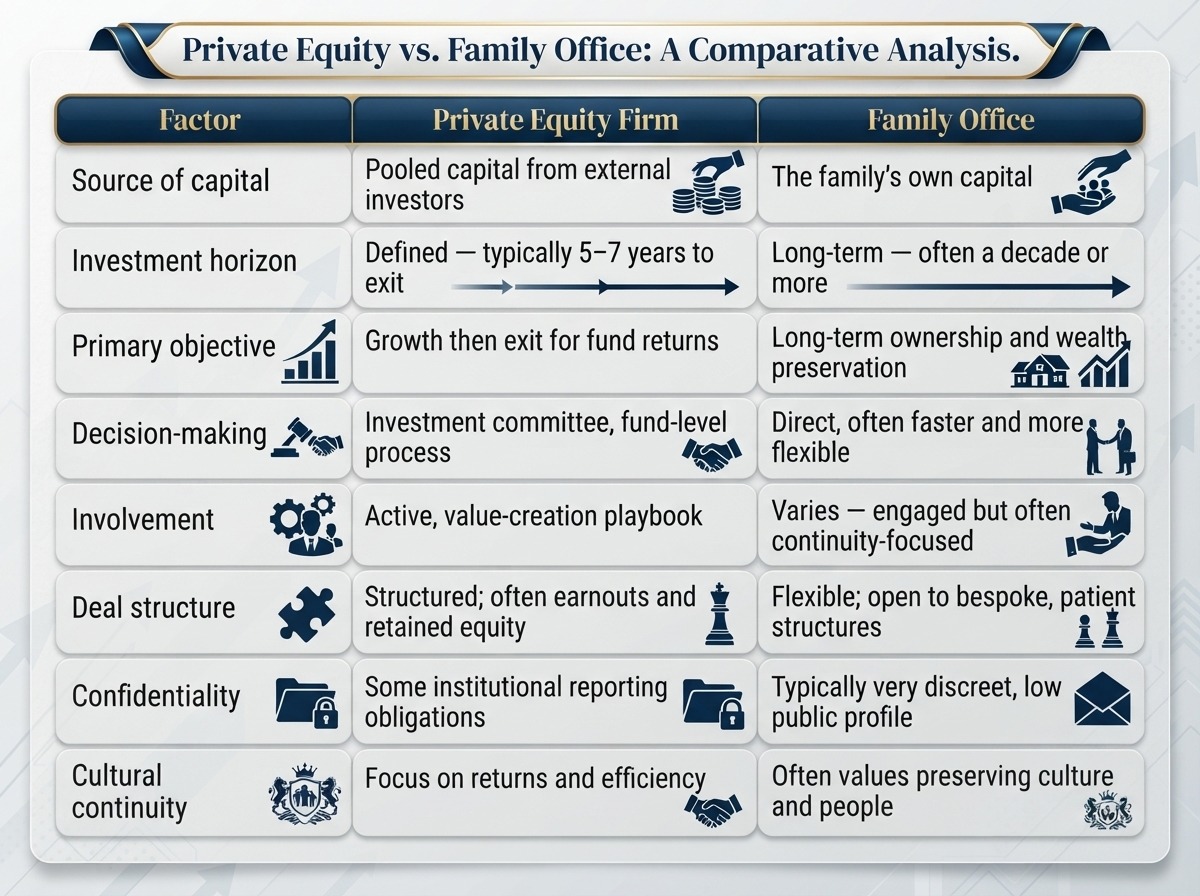
Investment Horizon: Short-Term Exit vs Long-Term Ownership
The clearest difference between private equity and a family office is time. Private equity firms work toward a defined exit, usually within five to seven years, because the fund itself has a finite life and investors expect their capital returned with a return. Family offices, investing their own money, face no such fund-level deadline and are frequently comfortable holding a business for a decade or more.
For a seller, this shapes the experience of the sale and what happens afterward. If you care primarily about maximising value through a growth-and-exit cycle, a private equity firm's model is built for exactly that. If you care about the long-term stability of the business and its people - not just the sale price - a family office's patient horizon can be more appealing.
Control, Involvement and Cultural Continuity
Private equity firms typically bring an active value-creation playbook - new reporting, operational improvements, add-on acquisitions, and a clear plan to grow earnings ahead of their own exit. Family offices are more varied: many are highly engaged owners, particularly where the family has direct operating experience in your sector, but they often place greater weight on preserving the culture and continuity of the business they acquire.
Owners who want to see the business, its brand, and its team carried forward largely intact often lean toward a family office. Owners who want a well-resourced partner to aggressively scale the business may prefer a private equity firm. Neither is right or wrong - it depends on what "a good outcome" means to you.
Deal Structure and Flexibility
Both private equity firms and family offices use blended deal structures rather than simple all-cash payments, but they flex differently. Private equity firms often structure deals with earnouts and retained equity, tying part of the price to future performance and keeping the founder invested through the growth phase. Family offices, drawing on their own capital and free of an investment committee, can often move faster and offer more bespoke, patient terms - including succession-friendly transitions where the founder steps back gradually rather than all at once.
Understanding how these structures affect what you actually receive is essential. Our guides on how to price a business to sell and business acquisition explained break down the common structures and how to evaluate offers on a genuine like-for-like basis.
Who Pays More - Private Equity or a Family Office?
There is no fixed answer to whether private equity firms or family offices pay more. Price depends on strategic fit, competitive tension in the process, and how each buyer values your specific business - not on the buyer category alone.
A private equity firm pursuing a platform or add-on acquisition in your exact sector may pay a premium because the business fits a defined growth thesis. Equally, a family office with deep experience in your industry may pay strongly for a business it intends to hold for the long term. The most reliable way to achieve a strong price from either is competitive tension - running a confidential, well-managed process that puts qualified private equity firms and family offices in front of your business at the same time. A credible investment memorandum and an honest valuation grounded in real market appetite are what make that possible.
Confidentiality: A Practical Difference for Sellers
Family offices generally transact quietly, without the public reporting requirements or investor communications that come with institutional private capital. Private equity firms, while still discreet, may carry some institutional reporting obligations. For owners who place a high value on confidentiality throughout the sale, this is a meaningful consideration - and one reason a controlled, private process matters regardless of buyer type. Our guide on how to sell a business confidentially explains how to protect sensitive information at every stage.
Which Buyer Is Right for Your Business?
The right buyer depends on your priorities. As a simple guide:
Choose a private equity firm if you want a well-capitalised partner to scale the business aggressively, you're comfortable with a defined growth-and-exit timeline, and maximising value through that cycle is your priority.
Choose a family office if long-term stability, cultural continuity, a discreet process, and a flexible or gradual transition matter as much to you as price.
Run a process that includes both if you want genuine competitive tension - which, in practice, is how most owners achieve the strongest combination of price and terms.
Crucially, you rarely have to choose the category upfront. A well-run sale process tests your business with qualified private equity firms and family offices simultaneously, then lets the best overall offer - on price and terms - emerge. That is where experienced representation earns its keep, as covered in why using a specialist advisor maximises your sale outcome.
Accessing Private Equity Firms and Family Offices
Both buyer types can be difficult to reach directly. Family offices in particular avoid public visibility and rarely respond to open marketing, so relationship-based introductions through a trusted advisor are usually the only reliable route to them. Private equity firms are more visible but are best approached through a credible, well-prepared process that signals a serious opportunity.
Blackmont Advisory is a boutique, senior-led M&A firm based in Melbourne with a global network of buyers, investors and partners - including active private equity firms and family offices with long investment horizons and a preference for direct ownership. We run confidential, managed sale processes that bring qualified buyers of both types to your business, never representing both sides of the same transaction, so our advice is structured independently for you. For the full picture, see our complete guide to selling a business and our approach to exit planning.
Whether the right buyer for your business is a private equity firm or a family office, the outcome is decided long before completion - in how well the process is prepared, positioned, and run.
Considering a sale? Start with a confidential valuation.
Frequently Asked Questions
What is the difference between private equity and a family office? A private equity firm invests pooled capital from external investors and works toward an exit, typically within five to seven years. A family office invests a single family's own capital and can hold a business for a decade or more. This difference in capital source and horizon shapes their control, flexibility, and approach to ownership.
Do private equity firms or family offices pay more for a business? Neither pays more as a rule. Price depends on strategic fit, competitive tension in the sale process, and how each buyer values your specific business. The strongest price usually comes from running a confidential process that puts qualified private equity firms and family offices in competition.
Is a family office better than private equity for selling my business? It depends on your priorities. Family offices often suit owners who value long-term stability, cultural continuity, discretion, and a flexible transition. Private equity firms suit owners who want a well-capitalised partner to scale the business through a defined growth-and-exit cycle.
What do private equity firms and family offices look for in a business? Both favour established, defensible businesses with a track record. Private equity firms particularly value recurring revenue and management depth beyond the founder; family offices often concentrate on sectors aligned with the family's own operating experience and prefer direct, outright ownership.
Can I sell to both private equity and family office buyers at once? You don't choose the category upfront. A well-run sale process approaches qualified private equity firms and family offices simultaneously, creating competitive tension and letting the best overall offer - on price and terms - emerge.